George Whitefield Biography: Great Awakening & Ministry
George Whitefield (1714-1770) was an Anglican evangelist who sparked the Great Awakening. Known for outdoor preaching and reaching millions across America and Britain.
- Quick Facts About George Whitefield
- Early Life and Family
- Education at Oxford
- Ordination and Early Ministry
- Revolutionary Preaching Style
- The Great Awakening in America
- Bethesda Orphanage
- Personal Life and Marriage
- Theological Positions
- Relationship with Benjamin Franklin
- Final Years and Death
- Legacy and Impact
- Final Thoughts
- Frequently Asked Questions
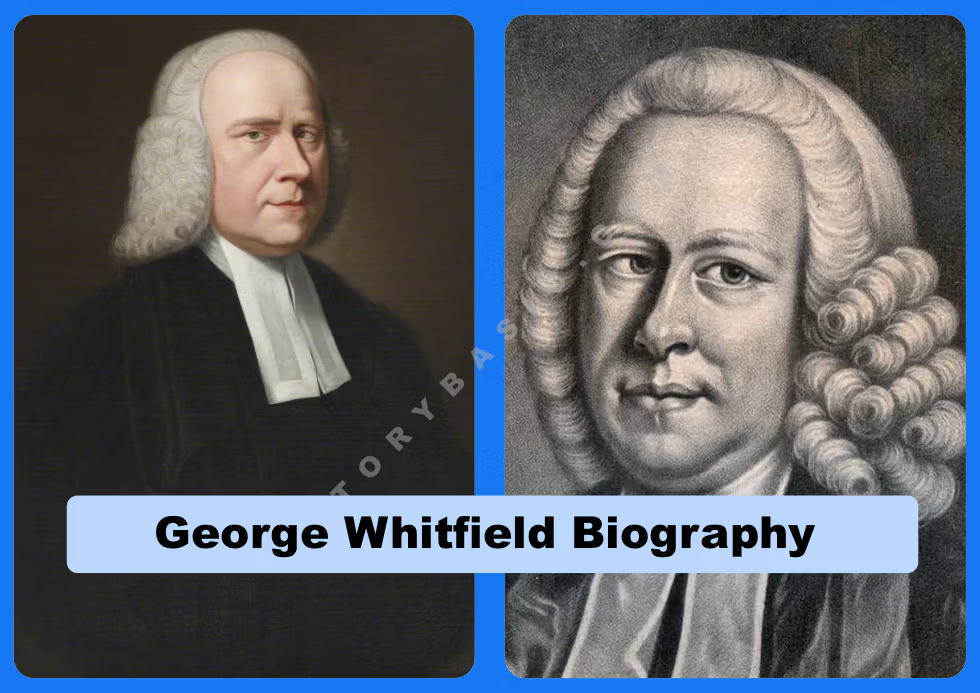
George Whitefield stands as one of the most influential religious figures of the 18th century. Born in Gloucester on December 27, 1714, he was an English Anglican priest and preacher who became one of the founders of Methodism and the evangelical movement. His revolutionary preaching style and passionate commitment to spreading the Gospel transformed religious life across two continents.
Whitefield preached at least 18,000 times to perhaps ten million listeners in the British Empire. His voice could reach thousands without amplification, and his dramatic delivery brought Biblical stories to life in unprecedented ways. Though less remembered today than some contemporaries, his impact on Christianity and American culture was profound and lasting.
Quick Facts About George Whitefield
| Detail | Information |
|---|---|
| Full Name | George Whitefield |
| Date of Birth | December 27, 1714 |
| Birthplace | Gloucester, England |
| Date of Death | September 30, 1770 |
| Age at Death | 55 years |
| Profession | Anglican Priest, Evangelist |
| Spouse | Elizabeth James (m. 1741-1769) |
| Famous For | Great Awakening, Open-Air Preaching |
| Major Work | Bethesda Orphanage |
| Sermons Preached | Approximately 18,000 |
Early Life and Family
George Whitefield was born at the Bell Inn on Southgate Street in Gloucester. He was the fifth son and seventh child of Thomas Whitefield and Elizabeth Edwards, who kept the inn. His father died when George was only two years old, leaving the family in difficult financial circumstances. Young George helped his mother manage the inn while growing up.
From an early age, Whitefield displayed a natural talent for performance and public speaking. He developed a passion for theater and acting, skills that would later prove invaluable in his preaching ministry. His theatrical abilities allowed him to captivate audiences and deliver sermons with extraordinary emotional power.
He was educated at The Crypt School in Gloucester. Despite his family’s financial struggles, Whitefield’s education provided him with a strong foundation. His early life was marked by typical youthful indiscretions, which he later candidly acknowledged in his writings.
Education at Oxford
Because business at the inn had diminished, Whitefield did not have the means to pay for his tuition. He therefore came up to the University of Oxford as a servitor, the lowest rank of undergraduates. In this capacity, he received free tuition in exchange for serving wealthier students, performing tasks like teaching, helping them bathe, and cleaning their rooms.
At Oxford, he joined the “Holy Club” and was introduced to John and Charles Wesley, with whom he would work closely in his later ministry. This group of earnest students pursued rigorous spiritual disciplines, visited prisoners, and engaged in charitable works. The experience profoundly shaped Whitefield’s spiritual development.
During his Oxford years, Whitefield underwent a profound spiritual crisis. His intense pursuit of holiness through self-denial and religious works nearly broke his health. He fasted extensively and practiced severe asceticism. A book by Scottish minister Henry Scougal titled “The Life of God in the Soul of Man” became instrumental in his conversion, helping him understand the concept of spiritual rebirth.
Ordination and Early Ministry
Whitefield was ordained after receiving his Bachelor of Arts degree. He immediately began preaching, but he did not settle as the minister of any Church of England parish; rather, he became an itinerant preacher and evangelist. His first sermon, delivered at St Mary de Crypt Church in Gloucester at age 21, reportedly led to complaints that he had driven fifteen people mad with religious fervor.
In his school and college days Whitefield experienced a strong religious awakening that he called a “new birth.” At their invitation he joined the Wesleys in their missionary work in the colony of Georgia in 1738. This initial journey to America introduced him to the needs of orphaned children in the colonies, a cause that would occupy him throughout his life.
Revolutionary Preaching Style
Whitefield’s preaching methods were revolutionary for his era. When church doors began closing to him due to his controversial message, he pioneered open-air preaching in England. At the suggestion of friends he preached to the miners of Kingswood, outside Bristol, in the open air. The response was overwhelming, with hardened miners moved to tears by his passionate delivery.
He relied heavily on extemporaneous preaching with a strong appeal to emotion and intellect through the use of theatrical and compelling oratory. His background in theater proved invaluable as he used dramatic gestures, vocal variations, and emotional intensity to bring Biblical narratives alive. Underlying this was his conviction that genuine religion “engaged the heart, not just the head.”
 Wife & Death (1945-2025)" loading="lazy" width="180" height="120">
Whitefield was a preacher who commanded audiences of thousands with only the use of his unamplified voice and charismatic personality. Benjamin Franklin once estimated that Whitefield’s voice could reach over 30,000 people in outdoor settings. His deep, musical voice combined with masterful delivery created an almost hypnotic effect on audiences.
The Great Awakening in America
In 1740, Whitefield traveled to British North America where he preached a series of Christian revivals that became part of the Great Awakening. His 1739-1740 tour of the American colonies became legendary. Though only 25 years old, the evangelist took America by storm. Whitefield’s farewell sermon on Boston Common drew 23,000 people—more than Boston’s entire population.
Whitefield traveled the colonies and influenced the Christian conversion of many—making the Awakening a national or inter-colonial movement. Approximately 80 percent of all American colonists heard him preach at least once, making him America’s first true celebrity. His influence extended beyond religion, helping create a shared colonial identity that would later contribute to revolutionary sentiment.
Whitefield was extremely focused on his teaching and preaching content. In his preaching, he primarily addressed the concept of the necessity of the New Birth. This message of personal conversion and spiritual regeneration resonated powerfully with colonists seeking authentic religious experience beyond formal church attendance.
Bethesda Orphanage
During his first visit to Georgia, Whitefield was moved by the plight of orphaned children. He determined to establish an orphanage that would provide care and Christian education. The Bethesda Orphanage, founded in 1740, became his lifelong passion and financial burden. He raised funds for the institution through offerings collected during his preaching tours throughout his ministry.
The orphanage represented Whitefield’s commitment to practical Christianity. While he is remembered primarily for preaching, he believed genuine faith must express itself through charitable works. The institution survived his death and continued serving children for generations.
Personal Life and Marriage
In 1741, Whitefield married Elizabeth James, a 36-year-old widow from Wales. Elizabeth gave birth to their only child in 1743, but the baby boy died only four months later. The couple never had additional children, dedicating themselves instead to ministry work.
Whitefield’s wife ministered by his side for 28 years until her death in London in 1769. Elizabeth proved to be the supportive helpmate Whitefield sought, accompanying him on arduous journeys and managing affairs during his frequent absences. Her death deeply affected him, occurring just one year before his own passing.
Theological Positions
Unlike the Wesley brothers, Whitefield embraced Calvinistic theology. Whitefield accepted a plain reading of Article 17—the Church of England’s doctrine of predestination—and disagreed with the Wesley brothers’ Arminian views on the doctrine of the atonement. This theological difference created tensions within the Methodist movement but did not destroy their friendship or mutual respect.
Whitefield’s sermons emphasized conviction of sin, justification by grace through faith, and the necessity of experiencing the new birth. He avoided abstract theological discourse, preferring to communicate doctrine through emotionally powerful preaching that called for immediate response.
Relationship with Benjamin Franklin
Whitefield developed an unlikely friendship with Benjamin Franklin, the American printer and statesman. Though Franklin remained a religious skeptic, he deeply admired Whitefield’s oratory and character. Franklin printed Whitefield’s journal, which became a bestselling publication. He even built a large auditorium in Philadelphia to accommodate the crowds unable to fit into churches when Whitefield preached.

The friendship illustrated Whitefield’s ability to transcend religious boundaries and win respect from diverse individuals. Franklin’s scientific estimates of how many people could hear Whitefield’s unamplified voice provided valuable historical documentation of the evangelist’s remarkable vocal power.
Final Years and Death
Whitefield’s preaching ministry spanned 33 years during which he traveled seven times to America, 15 times to Scotland, and exhaustively throughout England and Wales. The demanding schedule took a severe toll on his health. He often preached multiple times daily, sometimes suffering physical consequences including vomiting blood after intense sermons.
On the night of September 29, 1770, after preaching a two-hour sermon, Whitefield struggled with severe breathing difficulties. At 6:00 am on Sunday morning George Whitefield passed out of this life. The date was September 30, 1770. He was 55 years old. His death occurred in Newburyport, Massachusetts, where he was buried under the pulpit of the Old South Presbyterian Church.
Legacy and Impact
Whitefield received widespread recognition during his ministry; he preached at least 18,000 times to perhaps ten million listeners in the British Empire. His influence on evangelical Christianity cannot be overstated. He pioneered methods that would become standard in revivalist movements: field preaching, published magazines, conferences, and emotionally engaging delivery.
The Great Awakening he helped spark transformed colonial American religion and society. It democratized religious experience, challenged established church authority, and created networks of communication and shared identity across the colonies. These developments contributed to the revolutionary spirit that emerged decades later.
Despite his monumental impact, Whitefield remains less famous than some contemporaries. This obscurity may stem from his intentional focus on preaching rather than building lasting institutional structures or writing systematic theology. He chose to point people to Christ rather than build a personal legacy.
Final Thoughts
George Whitefield’s life exemplifies passionate devotion to evangelism. From humble beginnings as an innkeeper’s son, he became the most famous preacher in the English-speaking world. His revolutionary outdoor preaching brought the Gospel to unprecedented numbers of people across social classes and geographic boundaries.
His theatrical training, combined with genuine spiritual conviction, created a preaching style that moved thousands to tears and transformed communities. The Great Awakening he sparked reshaped American religious culture and contributed to the formation of American national identity. His establishment of Bethesda Orphanage demonstrated his commitment to practical Christian charity alongside evangelistic preaching.
Though less remembered today than figures like John Wesley or Jonathan Edwards, Whitefield’s influence on evangelical Christianity and American history was profound. He preached tirelessly until his strength was exhausted, literally wearing himself out in service to his calling. His legacy lives on in modern evangelistic methods and the millions whose lives were touched by his extraordinary ministry.
Frequently Asked Questions
Who was George Whitefield?
 Worth" loading="lazy" width="180" height="120">
George Whitefield was an English Anglican priest and evangelist born on December 27, 1714, in Gloucester, England. He became one of the founders of Methodism and a central figure in the Great Awakening religious revival. He preached approximately 18,000 sermons to millions of people across Britain and America during his 33-year ministry.
What was George Whitefield known for?
Whitefield was famous for his powerful outdoor preaching and dramatic delivery style. He pioneered field preaching when churches closed their doors to him, speaking to crowds of up to 30,000 people without amplification. He is best known for his role in sparking the Great Awakening in colonial America and for founding the Bethesda Orphanage in Georgia.
How did George Whitefield die?
George Whitefield died on September 30, 1770, in Newburyport, Massachusetts, at age 55. He passed away from respiratory failure just hours after preaching a two-hour sermon the previous evening. His demanding preaching schedule and intense delivery style had taken a severe toll on his health throughout his ministry.
What was George Whitefield’s preaching style?
Whitefield used theatrical techniques learned in his youth, including dramatic gestures, vocal variations, and emotional intensity. He preached extemporaneously, appealing to both emotion and intellect while making Biblical stories come alive. His deep, musical voice could reach thousands of listeners, and he often moved audiences to tears with his passionate delivery.
What was Whitefield’s relationship with John Wesley?
Whitefield and John Wesley were close friends who met at Oxford University’s “Holy Club.” While they co-founded the Methodist movement and worked together in ministry, they disagreed theologically. Whitefield embraced Calvinism while Wesley held Arminian views. Despite these differences, they maintained mutual respect and friendship throughout their lives.
Why isn’t George Whitefield more famous today?
Whitefield focused on preaching rather than building lasting institutional structures or writing systematic theology. He intentionally sought to point people to Christ rather than build a personal legacy. Additionally, he left leadership of the Methodist movement to John Wesley, whose organizational work ensured longer-lasting institutional recognition.
What was the Bethesda Orphanage?
Bethesda Orphanage was founded by Whitefield in 1740 near Savannah, Georgia, to care for orphaned children in the American colonies. It became his lifelong passion and financial responsibility. He raised funds for the institution throughout his ministry by taking offerings during his preaching tours across Britain and America.