T. S. Eliot Biography: Age, Poems, Books, Career and Literary Achievements
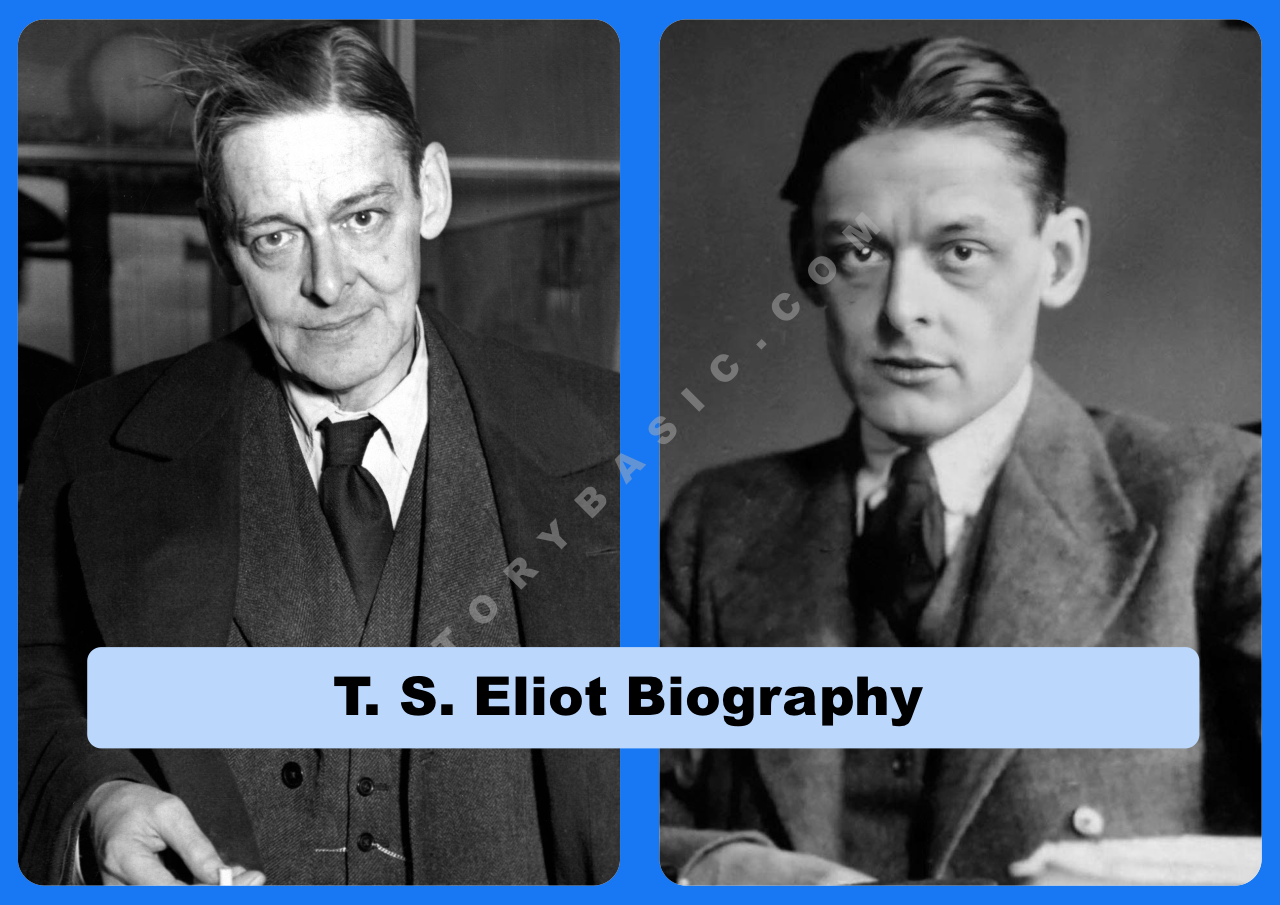
T. S. Eliot was an American-born British poet, playwright, literary critic and publisher who became one of the most influential writers of the 20th century. He is widely recognised for transforming modern poetry through his experimental writing style, complex imagery and exploration of human experiences. His most celebrated works include The Waste Land, The Love Song of J. Alfred Prufrock and Four Quartets.
Born Thomas Stearns Eliot on September 26, 1888, in St. Louis, Missouri, United States, he developed an interest in literature at an early age. He studied at Harvard University before continuing his education in Paris and Oxford. Eventually, he settled in England, became a British citizen and built an internationally respected literary career. In 1948, he received the Nobel Prize in Literature for his outstanding contribution to poetry.
Beyond writing poems, Eliot worked as a literary editor, publisher and playwright. His influence extended across different areas of literature, and his works continue to attract readers, students and researchers worldwide. He died on January 4, 1965, in London, England, at the age of 76.
Quick Facts About T. S. Eliot
| Information | Details |
|---|---|
| Full Name | Thomas Stearns Eliot |
| Popular Name | T. S. Eliot |
| Date of Birth | September 26, 1888 |
| Age at Death | 76 years |
| Birthplace | St. Louis, Missouri, USA |
| Date of Death | January 4, 1965 |
| Place of Death | London, England |
| Nationality | American-born British |
| Profession | Poet, Playwright, Critic and Publisher |
| Education | Harvard University, Sorbonne and Merton College, Oxford |
| Famous For | Modernist Poetry |
| Literary Movement | Modernism |
| First Wife | Vivienne Haigh-Wood |
| Second Wife | Esmé Valerie Fletcher |
| Parents | Henry Ware Eliot and Charlotte Champe Stearns |
| Nobel Prize | Nobel Prize in Literature, 1948 |
| Notable Works | The Waste Land, Four Quartets and Prufrock |
| Religion | Anglican Christian |
| Net Worth | No reliable public figure available |
Early Life and Family Background
Thomas Stearns Eliot was born on September 26, 1888, in St. Louis, Missouri, United States. He was the youngest child of Henry Ware Eliot and Charlotte Champe Stearns. His father was a successful businessman, while his mother was a writer who also had an interest in social work and education.
Eliot came from a prominent New England family with strong connections to education, religion and public service. His grandfather, William Greenleaf Eliot, was a respected Unitarian minister who played an important role in establishing educational and religious institutions in St. Louis. This family background exposed Eliot to intellectual discussions and cultural activities during his childhood.
He spent much of his early life in St. Louis, although his family also spent summers in Gloucester, Massachusetts. These experiences gave him exposure to different environments and contributed to his early understanding of American society. He developed an interest in reading and writing while attending school.
Eliot’s childhood was not entirely straightforward. He experienced health difficulties that sometimes limited his physical activities. However, reading provided an important source of entertainment and intellectual development. His early exposure to literature eventually influenced his decision to pursue a career in writing.
T. S. Eliot’s Education
T. S. Eliot received his early education at Smith Academy in St. Louis, where he studied from 1898 to 1905. During this period, he developed an interest in classical literature, languages and poetry. He also began writing poems and short stories that appeared in school publications.
In 1905, he moved to Massachusetts to attend Milton Academy. The school prepared him for university education and helped strengthen his academic interests. He subsequently enrolled at Harvard University in 1906, where he studied literature, philosophy, languages and other humanities subjects.
Eliot completed his undergraduate degree at Harvard in 1909. He continued his studies and earned a master’s degree in English literature in 1911. His academic interests gradually shifted towards philosophy, particularly the works of British philosopher F. H. Bradley.
Between 1910 and 1911, he studied at the Sorbonne in Paris, France. He later returned to Harvard for doctoral studies in philosophy before travelling to England in 1914. At Merton College, Oxford, he continued his philosophical studies and worked on his doctoral research.
Although he completed his doctoral dissertation, he did not formally receive his PhD because he did not return to Harvard to defend it. His education nevertheless provided a strong intellectual foundation for his later literary and critical works.
T. S. Eliot’s Literary Career
T. S. Eliot began developing his literary career while still studying at Harvard. He contributed poems to the university’s literary magazine, The Harvard Advocate, where his writing gradually attracted attention. His early influences included French Symbolist writers, particularly Charles Baudelaire and Jules Laforgue.
One of his earliest significant poems was The Love Song of J. Alfred Prufrock. Although he wrote much of it between 1910 and 1911, the poem was published in 1915 in the American literary magazine Poetry. It introduced readers to his distinctive writing style, which combined fragmented thoughts, vivid imagery and psychological exploration.
Eliot moved permanently to England in 1915. He initially worked as a teacher before joining Lloyds Bank in London in 1917. Despite his employment in banking, he continued writing poetry, reviewing books and contributing to literary publications.
In 1917, he published his first poetry collection, Prufrock and Other Observations. The collection helped establish his reputation among modern literary writers. His work attracted the attention of influential writers, including Ezra Pound, who became an important supporter and editorial adviser.
Eliot’s career expanded beyond poetry when he became involved in literary criticism and publishing. In 1922, he founded and edited The Criterion, an influential literary journal that published important writers and discussions about contemporary literature. He continued editing the publication until 1939.
In 1925, he joined the publishing company Faber and Gwyer, which later became Faber & Faber. He worked as a director and literary editor, helping publish the works of several important writers. His contribution to the publishing industry became another significant part of his professional legacy.
T. S. Eliot’s Most Famous Poems and Literary Works
T. S. Eliot produced several influential poems, plays and literary collections throughout his career. His writing explored themes such as loneliness, spirituality, modern civilisation, human relationships and the search for meaning.
Some of his most recognised works include:
1. The Love Song of J. Alfred Prufrock (1915)
The Love Song of J. Alfred Prufrock is one of Eliot’s earliest and most influential poems. It explores the thoughts of a socially anxious man who struggles with insecurity, isolation and the fear of rejection.
The poem uses dramatic monologue and fragmented imagery to reveal the character’s inner experiences. Its experimental structure helped establish Eliot as an important figure in modernist poetry.
2. The Waste Land (1922)
The Waste Land is widely regarded as one of the most important poems of the 20th century. Published in 1922, it explores the spiritual emptiness, cultural confusion and social uncertainty associated with modern civilisation.
The poem contains multiple voices, literary references, different languages and fragmented scenes. It reflects the disillusionment that followed the First World War and examines the difficulties of finding meaning in a changing world.
Ezra Pound played an important role in editing the original manuscript before publication. The poem helped establish Eliot’s international literary reputation.
3. The Hollow Men (1925)
The Hollow Men is another important poem that explores spiritual emptiness, weakness and the inability of individuals to take meaningful action. Its central ideas reflect the uncertainty and disillusionment associated with modern society.
The poem is particularly recognised for its memorable closing passage and its exploration of human failure. It remains one of Eliot’s most frequently studied works.
4. Ash Wednesday (1930)
Published in 1930, Ash Wednesday reflects Eliot’s growing interest in Christian spirituality and religious faith. The poem explores repentance, spiritual transformation and the search for redemption.
It represents an important stage in his development as a religious and philosophical writer. Its themes also reflect the influence of his conversion to Anglican Christianity in 1927.
5. Four Quartets (1943)
Four Quartets is widely considered Eliot’s greatest poetic achievement. It consists of four interconnected poems: Burnt Norton, East Coker, The Dry Salvages and Little Gidding.
The collection examines time, memory, spirituality, history and the relationship between human experiences and eternity. Eliot combines philosophical reflection with religious ideas to explore the meaning of existence.
The complete collection was published in 1943 and became one of his most respected literary works.
6. Old Possum’s Book of Practical Cats (1939)
Unlike many of Eliot’s serious and philosophical poems, Old Possum’s Book of Practical Cats is a collection of humorous poems about fictional cats. It was published in 1939 and demonstrated his ability to write entertaining poetry for a wider audience.
The collection later inspired Andrew Lloyd Webber’s internationally successful musical Cats. The stage production became one of the most recognised musical theatre adaptations of a literary work.
T. S. Eliot’s Career as a Playwright
Although Eliot became internationally famous for poetry, he also made important contributions to theatre. He believed that poetry could communicate effectively through dramatic performances and explored ways to combine traditional theatrical techniques with modern literary ideas.
One of his most recognised plays is Murder in the Cathedral, which premiered in 1935. The play focuses on the assassination of Thomas Becket, the Archbishop of Canterbury, in 1170. It explores religious conviction, political authority, sacrifice and the conflict between personal beliefs and public responsibility.
Another important production is The Family Reunion, published in 1939. The play examines family relationships, guilt, responsibility and spiritual conflict. It draws inspiration from Greek tragedy while incorporating Eliot’s distinctive poetic language.
His later play, The Cocktail Party, premiered in 1949 and was published in 1950. It became one of his most successful theatrical works and won the 1950 Tony Award for Best Play.
Other dramatic works include The Confidential Clerk and The Elder Statesman. Through these productions, Eliot demonstrated his ability to apply poetic techniques to the stage.
T. S. Eliot’s Religion and British Citizenship
Religion became increasingly important in Eliot’s personal life and literary development. On June 29, 1927, he was baptised into the Church of England and confirmed as an Anglican. His religious beliefs influenced several later poems, particularly Ash Wednesday and Four Quartets.
In the same year, he became a British citizen. This was an important milestone because he had spent much of his adult life in England after leaving the United States in 1914.
Eliot’s conversion and change of nationality reflected a significant transformation in his personal identity. He also became increasingly interested in Christian traditions, European culture and the relationship between literature and religion.
His later writing frequently explored questions about faith, morality, human responsibility and spiritual understanding.
T. S. Eliot’s Marriage and Personal Life
T. S. Eliot married Vivienne Haigh-Wood in 1915, shortly after settling in England. Vivienne was an English writer and dancer, and their relationship initially appeared promising. However, their marriage became increasingly difficult over the following years.
The couple experienced personal and emotional challenges, and Vivienne’s health deteriorated. They eventually separated in 1933, although they never formally divorced. Vivienne died in 1947 while receiving care at a psychiatric institution.
Eliot’s first marriage has attracted considerable attention from biographers and literary scholars. Researchers have examined its possible influence on his writing, particularly the emotional atmosphere of The Waste Land. However, the relationship between his private experiences and individual poems should not be reduced to a single explanation.
In 1957, Eliot married his second wife, Esmé Valerie Fletcher, who had worked as his secretary at Faber & Faber. Their marriage took place after several years of professional association.
Valerie was considerably younger than Eliot, but their relationship remained close until his death in 1965. After his passing, she played an important role in preserving his literary legacy and managing his papers.
Awards and Achievements
T. S. Eliot received several prestigious awards and honours during his lifetime. His contributions to poetry, literary criticism, publishing and theatre earned him international recognition.
Some of his most important achievements include:
- 1948 Nobel Prize in Literature: He received the award for his outstanding and pioneering contribution to contemporary poetry.
- 1948 Order of Merit: He was appointed to this prestigious British honour in recognition of his contribution to literature and culture.
- 1950 Tony Award: His play The Cocktail Party won the Tony Award for Best Play.
- 1964 Presidential Medal of Freedom: He received this honour from the United States in recognition of his cultural contributions.
- British Citizenship: He became a British citizen in 1927 after settling in England.
These achievements demonstrate the international significance of Eliot’s work. His influence extended beyond poetry into theatre, publishing and literary scholarship.
Controversies and Criticism of T. S. Eliot
Although T. S. Eliot is widely celebrated for his literary achievements, aspects of his personal beliefs and writings have attracted criticism. Scholars have particularly examined antisemitic language and prejudiced attitudes found in some of his early poetry, essays and private correspondence.
These criticisms have generated continuing discussions about how readers should approach his literary legacy. Some scholars distinguish between the artistic qualities of his writing and the prejudices expressed in parts of his work. Others argue that his views must remain an important part of any honest assessment of his influence.
His political, religious and cultural opinions have also attracted debate. Consequently, modern discussions of Eliot often consider both his contributions to literature and the limitations of some of his beliefs.
T. S. Eliot’s Death and Legacy
T. S. Eliot died on January 4, 1965, in London, England, at the age of 76. His death was attributed to emphysema, a serious lung disease. Following his death, his ashes were buried at St. Michael’s Church in East Coker, Somerset, England.
The choice of East Coker had personal significance because his ancestors originated from the village before emigrating to America. He had also used the village as the title of one of the poems in Four Quartets.
His influence on modern literature remains significant decades after his death. Writers, poets, academics and students continue to study his experimental techniques, philosophical ideas and contributions to literary criticism.
His works are regularly taught in universities and schools around the world. In addition, adaptations of his poetry and plays continue to appear in theatre productions and literary discussions.
The musical Cats, inspired by his collection of poems about cats, also introduced his writing to audiences who might not otherwise have encountered his poetry.
T. S. Eliot’s Net Worth and Earnings
T. S. Eliot’s exact net worth at the time of his death has not been reliably established through publicly available financial records. Therefore, specific figures published by some celebrity biography websites should not be treated as verified estimates.
During his lifetime, Eliot earned income through several professional activities. These included poetry publications, book sales, literary criticism, theatre productions, lectures and his long-standing position at Faber & Faber.
He also worked at Lloyds Bank between 1917 and 1925 before moving into publishing. His involvement in the literary industry provided a steady professional career alongside his creative work.
Although his books and literary rights have continued to generate commercial and cultural interest, there is insufficient reliable information to calculate his personal wealth accurately. His lasting contribution is better measured through his influence on modern literature than through an unverified financial figure.
Conclusion: Remembering T. S. Eliot and His Contribution to Literature
T. S. Eliot remains one of the most influential literary figures of the 20th century. Through poems such as The Waste Land, The Love Song of J. Alfred Prufrock and Four Quartets, he transformed modern poetry and introduced new ways of exploring human experiences, spirituality and modern civilisation.
His achievements extended beyond poetry into theatre, literary criticism and publishing. His 1948 Nobel Prize in Literature recognised his pioneering contribution to contemporary writing and confirmed his international reputation.
Although his personal beliefs and some aspects of his writing continue to attract criticism, his literary influence remains undeniable. More than six decades after his death, T. S. Eliot’s works continue to shape literary studies and inspire discussions about the development of modern literature.
Frequently Asked Questions About T. S. Eliot
1. Who was T. S. Eliot?
T. S. Eliot was an American-born British poet, playwright, literary critic and publisher. He is best known for The Waste Land, Four Quartets and his contribution to modernist literature.
2. What was T. S. Eliot’s real name?
T. S. Eliot’s full name was Thomas Stearns Eliot. He was born on September 26, 1888, in St. Louis, Missouri, United States.
3. How old was T. S. Eliot when he died?
T. S. Eliot was 76 years old when he died on January 4, 1965. He passed away in London, England.
4. What is T. S. Eliot famous for?
T. S. Eliot is famous for transforming modern poetry through experimental writing, complex imagery and philosophical themes. His best-known works include The Waste Land, The Love Song of J. Alfred Prufrock and Four Quartets.
5. Did T. S. Eliot win a Nobel Prize?
Yes, T. S. Eliot received the 1948 Nobel Prize in Literature. The award recognised his outstanding and pioneering contribution to contemporary poetry.
6. Who was T. S. Eliot’s wife?
T. S. Eliot had two wives during his lifetime. He married Vivienne Haigh-Wood in 1915 and Esmé Valerie Fletcher in 1957.
7. What were T. S. Eliot’s most famous books?
Some of T. S. Eliot’s most famous literary works include The Waste Land, Four Quartets, Prufrock and Other Observations, Ash Wednesday and Old Possum’s Book of Practical Cats. He also wrote plays such as Murder in the Cathedral and The Cocktail Party.
8. Why is T. S. Eliot important in English literature?
T. S. Eliot is important because he helped reshape modern poetry through experimental structures, literary references and philosophical themes. His writing influenced generations of poets, playwrights and literary critics.
9. Was T. S. Eliot American or British?
T. S. Eliot was born in the United States but became a British citizen in 1927. He spent most of his adult life in England and is recognised as an important figure in both American and British literature.
10. What caused T. S. Eliot’s death?
T. S. Eliot died from emphysema on January 4, 1965, in London, England. He was 76 years old at the time of his death.