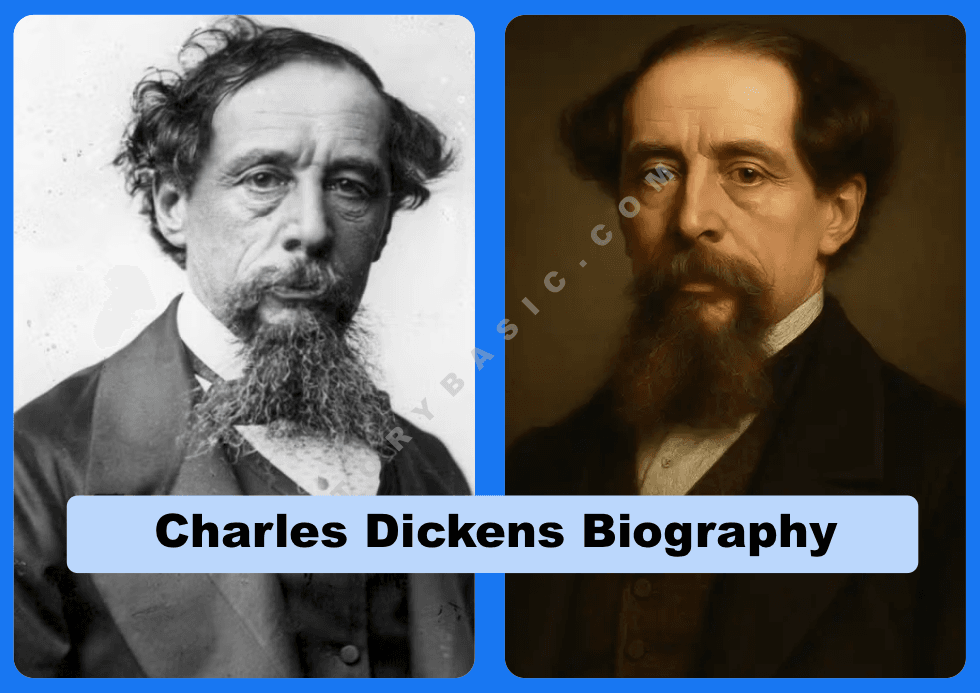
Charles Dickens Biography: Books, Wife & Legacy
Charles Dickens (1812-1870) was a Victorian novelist who wrote A Christmas Carol, Oliver Twist, Great Expectations. Married Catherine Hogarth, had 10 children. Literary genius.
- Quick Facts About Charles Dickens
- Early Life and Childhood Poverty
- The Blacking Factory Trauma
- Education and Early Career in Journalism
- Beginning as a Writer
- Marriage to Catherine Hogarth
- Growing Family and Literary Success
- Major Novels and Literary Achievements
- Social Reform and Public Impact
- Writing Style and Literary Innovation
- Marriage Breakdown and Separation
- Ellen Ternan and Final Years
- Death and Legacy
- Enduring Influence
- Final Thoughts
- Frequently Asked Questions
Charles Dickens stands as the greatest novelist of the Victorian era and one of the most influential writers in English literature. Born on February 7, 1812, in Portsmouth, England, he transformed personal hardship into timeless stories that exposed social injustice and celebrated the human spirit. His works including Oliver Twist, A Christmas Carol, David Copperfield, Great Expectations, and A Tale of Two Cities remain beloved classics nearly two centuries after their creation.
The author died at age 58 on June 9, 1870, but his legacy endures through characters like Ebenezer Scrooge, Oliver Twist, and Miss Havisham who live as vividly today as they did for his earliest readers. Dickens enjoyed wider popularity during his lifetime than any previous author, drawing readers from all levels of society. His deep interest in societal problems generated real change, and the term Dickensian still evokes the poverty, inequality, and harsh conditions he depicted.
Quick Facts About Charles Dickens
| Detail | Information |
|---|---|
| Full Name | Charles John Huffam Dickens |
| Date of Birth | February 7, 1812 |
| Date of Death | June 9, 1870 (aged 58) |
| Birthplace | Portsmouth, England |
| Profession | Novelist, Journalist, Social Critic, Editor |
| Spouse | Catherine Hogarth (m. 1836, separated 1858) |
| Children | 10 children |
| Famous Works | Oliver Twist, A Christmas Carol, Great Expectations |
| Legacy | Greatest Victorian novelist |
Early Life and Childhood Poverty
Charles was born at 1 Mile End Terrace in Landport, Portsmouth, the second of eight children born to John and Elizabeth Dickens. His father worked as a clerk in the Royal Navy Pay Office but was charming yet financially irresponsible. Christopher Huffam, a rigger in the Royal Navy, served as Charles’s godfather and later inspired the character of Paul Dombey in Dombey and Son.
In January 1815, John Dickens was recalled to London, and the family moved to Norfolk Street in Fitzrovia. When Charles was four, they relocated to Sheerness and then to Chatham, Kent, where he spent formative years until age eleven. His early life seemed idyllic, though he thought himself not particularly well cared for. The family moved constantly throughout his childhood, a pattern that would deeply influence his later work.
This period came to an abrupt end in June 1822 when the family moved to Camden Town in London amid mounting debts. Living beyond his means, John Dickens was forced by creditors into the Marshalsea debtors’ prison in Southwark in 1824. His wife and youngest children joined him there, as was the practice at the time. Twelve-year-old Charles boarded with family friend Elizabeth Roylance, whom he later immortalized as Mrs. Pipchin in Dombey and Son.
The Blacking Factory Trauma
While his family lived in the debtors’ prison, young Charles was sent to work at Warren’s Blacking Factory, pasting labels on bottles of shoe polish. He had left school at age ten to help support the family. He worked long hours in squalid conditions supervised by cruel masters, living in a miserable lodging house. Small audiences gathered to watch the child laborers work, which Dickens later described as a new refinement added to his misery.
Though this traumatic period lasted only four months before his father received an unexpected inheritance and was released, the experience shaped the rest of Dickens’s life. He came to believe that money and position in Victorian England meant everything. He later wrote that it was wonderful to him how he could have been so easily cast away at such an age.
His mother’s response wounded him deeply. When John Dickens pitied his son and removed him from the factory, Elizabeth Dickens thought Charles should stay to continue providing income. Years later, Dickens wrote: “I never afterwards forgot, I never shall forget, I never can forget, that my mother was warm for my being sent back.” This maternal failure influenced his dissatisfied attitude toward women and his belief that fathers should rule families.
Very few people knew these details until six years after his death when biographer John Forster published them. Dickens was ashamed of this period and would not reveal that this was where he gathered his realistic accounts of squalor. He channeled the experience into David Copperfield, though readers didn’t realize the autobiographical nature until after his death.
Education and Early Career in Journalism
After his father’s release from prison, Charles returned to school briefly before economic pressures intervened again. When Dickens was fifteen in 1827, he had to drop out and work as an office boy at a solicitor’s office to contribute to family income. However, the job became a launching point for his writing career.
Within a year, Dickens began freelance reporting at the law courts of London. He became a shorthand reporter and gained knowledge of the legal world that would feature prominently in novels like Bleak House. Just a few years later, he was reporting for two major London newspapers. These years left him with lasting affection for journalism and contempt for both law and Parliament.
Much drawn to theater, Dickens nearly became a professional actor in 1832. His coming-of-age in the reformist 1830s, particularly working for the Liberal Morning Chronicle from 1834 to 1836, greatly affected his political outlook. Another influential event was his rejection as suitor to Maria Beadnell because his family and prospects were unsatisfactory. His hopes of gaining and chagrin at losing her sharpened his determination to succeed.
Beginning as a Writer
In 1833, Dickens began submitting sketches to various magazines and newspapers under the pseudonym Boz, a family nickname. His first published story was A Dinner at Poplar Walk, which ran in the Monthly Magazine. Seeing his writing in print made his eyes overflow with joy and pride, according to his biography.
In February 1836, these clippings were published in his first book, Sketches by Boz. Publishers Edward Chapman and William Hall were so impressed that they asked Dickens to write a series of stories to accompany illustrations by popular comic artist Robert Seymour. Their plan was for twenty monthly installments selling for one shilling each. Dickens’s friends warned this format might cheapen his reputation, but he found the opposite.
Known as The Pickwick Papers, the serial was enormously successful both critically and popularly, making Dickens a celebrity at age twenty-four. Within a few months, Pickwick was the rage and Dickens became the most popular author of the day. This pioneering use of serial publication made stories affordable and accessible, with audiences more evenly distributed across income levels than before.
Marriage to Catherine Hogarth
On April 2, 1836, after a one-year engagement and between episodes of The Pickwick Papers, Dickens married Catherine Thomson Hogarth. She was the daughter of George Hogarth, editor of the Evening Chronicle where Dickens worked. They married at St. Luke’s Church in Chelsea, London. After a brief honeymoon in Chalk, Kent, the couple returned to lodgings at Furnival’s Inn.

Catherine was a smart, good-looking twenty-year-old when she met Charles in 1835. She grew up in a good family as the daughter of an editor, musicologist, music critic, and publisher. Dickens dreamed of having a strong, loving family and a wife who would be a good housewife and mother. He often addressed her as “my best half” and “my dearest wife” in the early years.
The first of their ten children, Charles Culliford Boz Dickens, was born in January 1837. In March 1837, the family moved to 48 Doughty Street in Bloomsbury, London. Dickens’s younger brother Frederick and Catherine’s seventeen-year-old sister Mary Hogarth moved in with them. Dickens became very attached to Mary, and when she died in his arms after a brief illness later that year, he was so shocked that he stopped working for a fortnight. She became a character in many of his books, and her death was fictionalized as the death of Little Nell.
Growing Family and Literary Success
Catherine became pregnant almost immediately after marriage, and the couple had ten children over fifteen years along with at least two miscarriages. During this period, Charles wrote that even if he became rich and famous, he would never be as happy as in that small flat with Catherine. However, the reality of constant pregnancies, childcare, and household management took its toll.
Their children were Charles Jr., Mary, Kate, Walter, Francis, Alfred, Sydney, Henry, Dora, and Edward. Most were named after famous friends of Dickens. Catherine acted in her husband’s plays, wrote a cookbook called What Shall We Have for Dinner published in 1851, and proved to be a good travel companion. Before their fifth child, the Dickens family traveled to America in 1842, with Catherine overcoming difficult circumstances.
In January 1842, Catherine’s sister Georgina Hogarth joined the household to help care for the growing family. She remained with them as housekeeper, organizer, adviser, and friend until Dickens’s death in 1870. Dickens modeled the character Agnes Wickfield in David Copperfield after Georgina and Mary. Georgina’s presence would later become controversial during the marriage breakdown.
Major Novels and Literary Achievements
Dickens wrote fifteen major novels during his career. Oliver Twist, published in 1838 and first appearing in serialized installments in Bentley’s Miscellany, brought the plight of workhouse children to public attention. The novel’s depiction of the criminal underworld and child exploitation shocked readers while demonstrating Dickens’s gift for creating memorable characters like the Artful Dodger and Fagin.
A Christmas Carol, arguably his most popular work, was written in late 1843 while working on Martin Chuzzlewit. Suddenly conceived and dashed off in a few weeks, it followed miserly Ebenezer Scrooge’s transformation after ghostly visits teaching him the spirit of Christmas. Published December 19, 1843, it sold out its first printing of six thousand copies by Christmas Eve. The story essentially invented the Christmas book genre and forever shaped how many view the holiday.
David Copperfield, published between 1849 and 1850, was Dickens’s personal favorite among his novels. In the 1867 edition preface, he wrote: “Like many fond parents, I have in my heart of hearts a favourite child. And his name is David Copperfield.” Biographer John Forster noted that underneath the fiction lay something of the author’s life. Dickens had begun writing an autobiography in the late 1840s but found it too painful, opting instead to work his story into this fictional account.
Bleak House, published 1852 to 1853, dealt with the hypocrisy of British society and was considered his most complex novel yet. Drawing upon experiences as a law clerk and court reporter, it built around a long-running legal case involving conflicting wills. The first of his dark novels, it used the toxic London fog to symbolize society’s ills toward the downtrodden.
Social Reform and Public Impact
Dickens’s writing empathized with the poor and helpless while mocking the selfish, greedy, and cruel. His novels exposed workhouses, debtors’ prisons, child labor, legal corruption, and class inequality. These weren’t merely literary themes but calls for social reform. His depictions of squalor came from lived experience, giving them rare authenticity that moved readers to action.
In 1842, he visited America for the first time and shocked hosts by denouncing slavery. He published American Notes upon returning to England, criticizing many aspects of American life and setting off a furor. Dickens depicted his low opinion of American manners in Martin Chuzzlewit. Despite the controversy, his anti-slavery stance demonstrated his willingness to challenge injustice regardless of personal cost.
He busied himself with charities including schools for poor children and a loan society to assist poor people immigrating to Australia. In the 1850s, he helped save Great Ormond Street Hospital during its first major financial crisis. His Drooping Buds essay was considered the catalyst for the hospital’s success. The hospital’s founder Charles West asked Dickens to preside over an appeal, and he threw himself into the task with characteristic energy.
Writing Style and Literary Innovation
Dickens employed Cockney English in many works, denoting working-class Londoners. Cockney grammar appears in terms like “ain’t,” and consonants are frequently omitted, as in “ere” for here and “wot” for what. In Oliver Twist, the Artful Dodger uses cockney slang juxtaposed with Oliver’s proper English. Biographer Claire Tomalin regards him as the greatest creator of character in English fiction after Shakespeare.
He refined his style throughout the 1840s, widening his range with literary devices like symbolism. He still offered funny, irreverent characters and situations, but his tone became somewhat bitter, often taking the form of biting satire. His instalment format inspired a narrative he would explore throughout his career, and regular cliffhangers made each new episode eagerly anticipated.
Dickens briefed illustrators on plans for each month’s instalment so work could begin before he wrote them. Marcus Stone, illustrator of Our Mutual Friend, recalled the author was always ready to describe down to minutest details the personal characteristics and life history of his creations. This attention to detail made his characters extraordinarily vivid and memorable.
Marriage Breakdown and Separation
Over time, Dickens grew unhappy with Catherine and their marriage. He resented supporting so many children, somehow seeing this as Catherine’s fault. He criticized her lack of energy and began indicating she was not nor had ever been his intellectual equal. In 1855, discontent led him to meet former girlfriend Maria Beadnell, now Mrs. Henry Winter, but she didn’t live up to romantic memories.
The breaking point came in May 1858 when Catherine accidentally received a bracelet meant for actress Ellen Ternan. Her daughter Kate said Catherine was distraught. Charles insisted Catherine go to Ternan, hand her the bracelet, and apologize for insulting behavior. Catherine couldn’t take it anymore and left.
In June 1858, they legally separated. Catherine moved to a house on Gloucester Crescent in Camden Town, taking only their eldest son Charles Jr. Dickens retained custody of the other eight surviving children. After publicly accusing Catherine of not loving their children and suffering from a mental disorder, statements that disgusted contemporaries including Elizabeth Barrett Browning, Dickens attempted to have Catherine institutionalized.
When his scheme failed, they permanently separated. Catherine lived another twenty years after separation, dying in 1879. Deprived of both wife and mother roles, she never recovered from the marriage breakup. Most of their daughters didn’t invite her to their weddings or inform her of Walter’s death. The public nature of the separation damaged both their reputations, though Dickens’s fame protected him more than it protected her.
Ellen Ternan and Final Years
Dickens began a relationship with actress Ellen Ternan in 1857, though they reportedly became lovers only five years after his divorce. He went to great lengths to erase documentation alluding to Ternan’s presence in his life. In early September 1860, he made a bonfire of most of his correspondence behind Gad’s Hill, sparing only business letters. Since Ternan also destroyed all his letters to her, the extent of their affair remains speculative.
Biographer Claire Tomalin’s book The Invisible Woman argues Ternan lived with Dickens secretly for the last thirteen years of his life. Dickens’s daughter Kate Perugini stated to biographer Gladys Storey that the two had a son who died in infancy, though no contemporary evidence was given. On his death, Dickens settled an annuity on Ternan making her financially independent.
During this period, Dickens gave public readings for pay, traveling throughout Britain and America. These performances were enormously popular, showcasing his theatrical talents. Near the end of his life, he was performing dramatic readings including the murder of Nancy from Oliver Twist. The physical and emotional strain of these tours, combined with heavy writing schedules, wore him down.
Death and Legacy
On June 8, 1870, Dickens collapsed from a stroke at his home Gad’s Hill Place near Chatham in Kent after a day of writing The Mystery of Edwin Drood. He died the next day at age fifty-eight, worn out with work and travel. Edwin Drood had begun serial publication but was never finished. Only half the planned installments were completed.
He wished to be buried without fanfare in a small cemetery in Rochester, Kent, but the nation would not allow it. He was laid to rest in Poet’s Corner at Westminster Abbey. Flowers from thousands of mourners overflowed the open grave. Among beautiful bouquets were many simple clusters of wildflowers wrapped in rags, symbolizing the working-class readers who loved him.
When news of his death spread, a London costermonger’s girl reportedly exclaimed: “Dickens dead? Then will Father Christmas die too?” This poignant reaction captured how deeply associated he had become with Christmas and the values of compassion and generosity. His influence on the Christmas celebration through A Christmas Carol and other Christmas books remains profound today.
Enduring Influence
Dickens’s legacy lives on through literature, film, and theater. A Christmas Carol alone has over one hundred filmed adaptations, with actors from Michael Caine to Jim Carrey portraying Scrooge. His other works have been adapted countless times, keeping characters like Oliver Twist, Pip, and Miss Havisham alive for new generations.
His social criticism influenced reform movements addressing child labor, debtors’ prisons, and education. The word Dickensian entered the language as an adjective describing both his writing style and the social conditions he depicted. Writers from Margaret Atwood to Salman Rushdie cite his influence on their work.
More than fourteen thousand of his letters survive, covering wide-ranging subject matter. His magazines Household Words and All the Year Round shaped Victorian journalism and literature. His pioneering use of serialization changed how fiction was published and consumed. His ability to blend entertainment with social commentary created a template followed by countless authors.
Final Thoughts
Charles Dickens transformed personal suffering into universal stories that continue resonating nearly two centuries after his death. Born into financial instability and forced into child labor at age twelve, he channeled these traumatic experiences into literature that exposed Victorian society’s cruelties while celebrating human dignity and resilience. His fifty-eight years produced fifteen major novels, numerous short stories, essays, and five Christmas books that defined a genre.
His personal life was complex and often troubled. Ten children, a painful separation from his wife, a secret relationship with a younger actress, and relentless work schedules marked his later years. Yet he maintained phenomenal creative output while championing social reform through both writing and charitable work. The contradictions between his public championing of family values and his treatment of Catherine remain uncomfortable aspects of his legacy.
What endures most powerfully is the work itself. Characters like Scrooge, Oliver Twist, David Copperfield, Pip, and Miss Havisham live as vividly today as when first created. His ability to make readers laugh, cry, and feel moral outrage remains undiminished. He drew readers from all social classes during his lifetime and continues doing so today. Charles Dickens stands not just as the greatest Victorian novelist but as one of the finest storytellers in the English language, whose compassion for the downtrodden and gift for vivid characterization ensure his immortality in literature.
Frequently Asked Questions
Q1: Who was Charles Dickens?
Charles Dickens was a British novelist, journalist, and social critic born February 7, 1812, in Portsmouth, England. He wrote fifteen major novels including Oliver Twist, A Christmas Carol, David Copperfield, and Great Expectations. He died June 9, 1870, at age fifty-eight and is considered the greatest novelist of the Victorian era.
Q2: What were Charles Dickens’s most famous books?
His most famous works include A Christmas Carol, Oliver Twist, David Copperfield, Great Expectations, A Tale of Two Cities, and Bleak House. A Christmas Carol sold over two million copies in America alone in the century after publication. David Copperfield was his personal favorite among his novels.
Q3: How many children did Charles Dickens have?
Charles Dickens and his wife Catherine had ten children: Charles Jr., Mary, Kate, Walter, Francis, Alfred, Sydney, Henry, Dora, and Edward. Most were named after famous friends. Their daughter Dora died at eight months old. When the couple separated in 1858, Catherine took only their eldest son while Dickens kept the other children.
Q4: Why did Charles Dickens and his wife separate?
Dickens grew unhappy with Catherine over years, resenting their many children and claiming she lacked energy and intelligence. In 1858, Catherine accidentally received a bracelet meant for actress Ellen Ternan, with whom Dickens was involved. They legally separated in June 1858. Dickens attempted to have Catherine institutionalized and publicly accused her of mental illness and not loving their children.
Q5: What was Charles Dickens’s childhood like?
Dickens’s childhood was marked by financial instability. When he was twelve, his father was imprisoned for debt, and Charles was sent to work in a blacking factory pasting labels on shoe polish bottles. This four-month traumatic period profoundly affected him. He kept this shameful experience secret until after his death, though it heavily influenced his later writings about poverty and social injustice.
Q6: How did Charles Dickens die?
Charles Dickens died of a stroke on June 9, 1870, at age fifty-eight at his home Gad’s Hill Place near Chatham, Kent. He collapsed on June 8 after a day of writing The Mystery of Edwin Drood, which remained unfinished. Despite wishing for a quiet burial in Rochester, he was laid to rest in Poet’s Corner at Westminster Abbey.
Q7: What is Charles Dickens’s legacy?
Dickens is remembered as the greatest Victorian novelist and one of English literature’s finest writers. His works exposed social injustice, particularly child labor and poverty, influencing real reform. The word Dickensian entered the language to describe his writing style and the conditions he depicted. His characters remain culturally relevant through countless adaptations, and he essentially invented the modern Christmas celebration through A Christmas Carol.