Elizabeth Blackwell Biography: First Woman Doctor
Discover Elizabeth Blackwell’s inspiring journey as America’s first female doctor. Learn about her groundbreaking medical career, challenges, and lasting impact.
- Quick Facts About Elizabeth Blackwell
- Early Life and Family Background
- Education and the Path to Medicine
- Breaking Barriers at Geneva Medical College
- Medical Career and Professional Achievements
- Founding the New York Infirmary
- British Medical Register and International Influence
- Personal Life and Relationships
- Later Years and Lasting Contributions
- Death and Enduring Legacy
- Final Thoughts
- Frequently Asked Questions
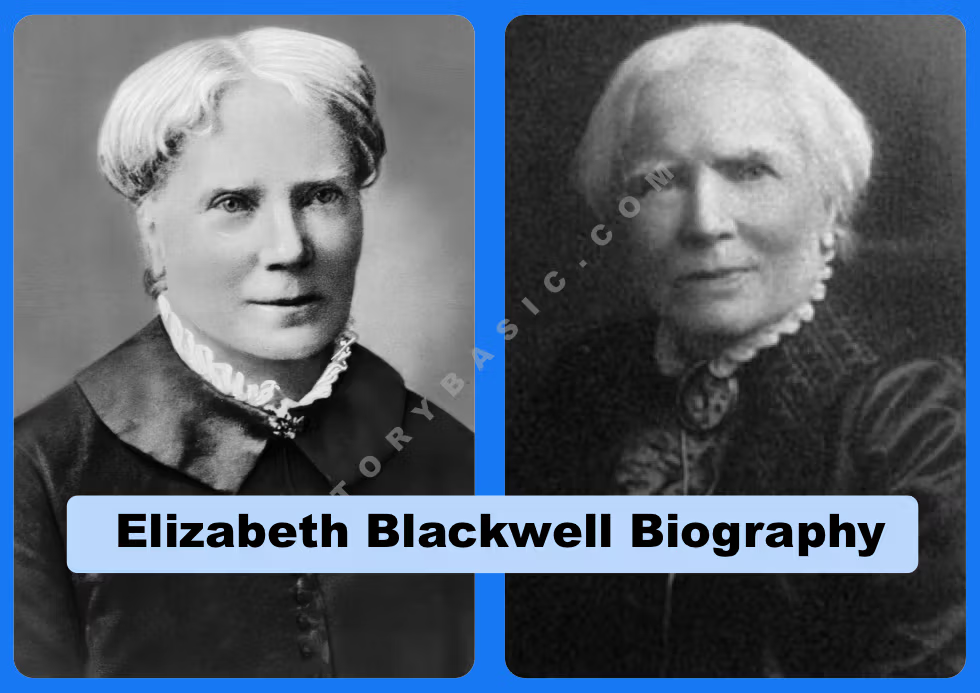
Elizabeth Blackwell stands as one of history’s most courageous medical pioneers. Born in England in 1821, she became the first woman to earn a medical degree in the United States and the first woman on the British Medical Register. Despite facing rejection from nearly every medical school, constant ridicule, and social isolation, she persevered to become a physician, educator, and reformer who opened doors for countless women in medicine.
Quick Facts About Elizabeth Blackwell
| Detail | Information |
|---|---|
| Full Name | Elizabeth Blackwell |
| Date of Birth | February 3, 1821 |
| Place of Birth | Bristol, England |
| Date of Death | May 31, 1910 (age 89) |
| Profession | Physician, Social Reformer, Educator |
| Famous For | First woman to earn a medical degree in the United States |
| Education | Geneva Medical College (MD, 1849) |
| Major Achievement | First woman on British Medical Register (1859) |
| Adopted Daughter | Katherine “Kitty” Barry |
| Legacy | Elizabeth Blackwell Medal for women in medicine |
Early Life and Family Background
Elizabeth Blackwell was born on February 3, 1821, in Bristol, England, as the third of nine children to Samuel and Hannah Blackwell. Her father, a sugar refiner and devoted Quaker, was passionate about social reform and anti-slavery activism. Unlike most families of that era, the Blackwells educated daughters equally with sons. The family immigrated to the United States in 1832 when Elizabeth was eleven. They settled in Cincinnati, Ohio, in 1838. Tragically, Samuel Blackwell died shortly after, leaving the family in financial hardship. Elizabeth and her sisters became teachers to support the family.
Education and the Path to Medicine
Elizabeth worked as a teacher in Cincinnati, Kentucky, and the Carolinas. While teaching provided income, she found it unfulfilling and longed for greater purpose. Her life changed when her dying friend Mary Donaldson expressed distress over the lack of female physicians. Donaldson urged Elizabeth to study medicine, suggesting women could offer more empathetic care. Initially repulsed, Blackwell eventually embraced the idea. While teaching, she boarded with southern physicians who mentored her. She saved money and began applying to medical schools in 1847, facing rejection after rejection because she was a woman.
Breaking Barriers at Geneva Medical College
After persistent efforts, Elizabeth applied to Geneva Medical College in New York. The dean allowed the all-male student body to vote on her admission, assuming they would reject her. The students voted yes as a joke, making Blackwell the first woman admitted to medical school in the United States in 1847. Her time at Geneva was challenging. Professors excluded her from labs, and townspeople shunned her. One professor asked her to leave reproductive anatomy class, but she convinced him to let her stay. Despite obstacles, her dignity and exceptional performance won over classmates and professors. She graduated first in her class in 1849.
Medical Career and Professional Achievements
Blackwell sought additional training in Europe. In Paris at La Maternité, she contracted an eye infection while treating a baby, losing sight in one eye. This ended her surgical dream, but she continued training at St. Bartholomew’s Hospital in London. Returning to New York in 1851, she faced rejection for physician positions because of her gender. Undaunted, she established a private practice. In 1852, Blackwell began lecturing and published “The Laws of Life with Special Reference to the Physical Education of Girls.” In 1853, she opened a dispensary near Tompkins Square.
Founding the New York Infirmary
Blackwell’s sister Emily, also a physician, joined her practice. Together with Dr. Marie Zakrzewska, they founded the New York Infirmary for Indigent Women and Children in 1857. This institution treated poor patients and trained women medical students. By 1866, nearly 7,000 patients were treated annually. In 1868, they opened the Woman’s Medical College with innovative four-year training including extensive clinical practice.
 Worth & Career" loading="lazy" width="180" height="120">
British Medical Register and International Influence
Blackwell made trips to Britain to raise funds and establish similar projects. Due to the Medical Act 1858, she became the first woman on the General Medical Council’s register on January 1, 1859. During England visits, she lectured about women’s medical education. Elizabeth Garrett Anderson attended one lecture and later became the first woman doctor in England in 1865. In 1874, Blackwell worked with Florence Nightingale and others to create the London School of Medicine for Women, serving as Chair of Hygiene.
Personal Life and Relationships
None of the Blackwell sisters married. Elizabeth prized her independence, commenting she could not find her other half, only about a sixth. In 1854, she adopted Katherine “Kitty” Barry, an Irish orphan. Kitty remained devoted to Elizabeth for fifty-six years. On her deathbed in 1936, Barry called Blackwell her true love. Blackwell maintained friendships with reformers including Florence Nightingale, though they later clashed when Nightingale wanted Blackwell to focus on nursing rather than physician training.
Later Years and Lasting Contributions
Blackwell settled in England in 1869, continuing advocacy for women in medicine. She founded the National Health Society in 1871, educating people about hygiene and healthy lifestyles. Their motto “Prevention is better than Cure” remains relevant. She wrote extensively on medical ethics and women’s health. In 1895, she published her autobiography, “Pioneer Work in Opening the Medical Profession to Women.” She influenced 476 women to become registered medical professionals in England.
Death and Enduring Legacy
Elizabeth Blackwell died on May 31, 1910, in Hastings, England, at age 89. She left a legacy that transformed medicine and opened doors for generations of women physicians. Her contributions are celebrated with the Elizabeth Blackwell Medal, awarded annually to women promoting women in medicine. Her pioneering work proved women could excel in medicine and deserved equal access to medical education.
 Worth & Awards" loading="lazy" width="180" height="120">
Final Thoughts
Elizabeth Blackwell’s story represents the beginning of a revolution in medicine and women’s rights. She faced rejection, ridicule, and isolation, yet never wavered in her commitment to becoming a physician. Her legacy lives on in every woman who practices medicine today. Elizabeth Blackwell proved that courage and conviction can change the world.
Frequently Asked Questions
Q1: Who was Elizabeth Blackwell?
Elizabeth Blackwell was an English-American physician who became the first woman to earn a medical degree in the United States in 1849. She was also the first woman registered on the British Medical Register in 1859.
Q2: How did Elizabeth Blackwell become a doctor?
After being rejected by multiple medical schools, Blackwell was accepted to Geneva Medical College in New York in 1847 when male students voted to admit her as a joke. She graduated first in her class.
Q3: Did Elizabeth Blackwell ever marry?
No, Elizabeth Blackwell never married. She valued her independence. However, in 1854, she adopted a seven-year-old Irish orphan named Katherine “Kitty” Barry who remained her devoted companion for fifty-six years.
Q4: What hospitals did Elizabeth Blackwell found?
In 1857, Blackwell founded the New York Infirmary for Indigent Women and Children. In 1868, they added the Woman’s Medical College. She also helped establish the London School of Medicine for Women in 1874.
Q5: What happened to Elizabeth Blackwell’s eye?
While training in Paris, Blackwell contracted an eye infection while treating a baby with the same disease. The infection caused her to lose sight in one eye, ending her dream of becoming a surgeon.