Ray Bradbury Biography: Age, Books & Fahrenheit 451
Ray Bradbury (1920-2012) was an American author best known for Fahrenheit 451. Discover his life, major works, awards, and lasting literary legacy.
- Quick Facts About Ray Bradbury
- Early Life and Family Background
- Education and Self-Learning
- The Beginning of a Writing Career
- Marriage and Family Life
- Literary Breakthrough and Major Works
- Other Notable Works
- Film and Television Career
- Space Age Visionary
- Awards and Honors
- Writing Philosophy and Style
- Later Years and Death
- Legacy and Cultural Impact
- Final Thoughts
- Frequently Asked Questions
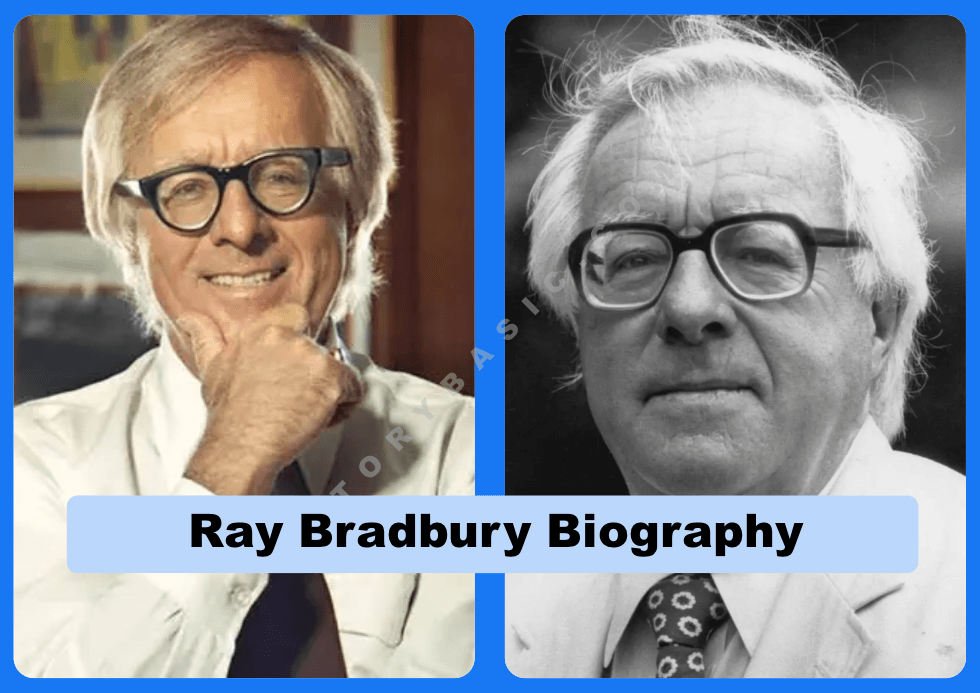
Ray Bradbury stands as one of the most celebrated American authors of the 20th century. Born August 22, 1920, in Waukegan, Illinois, he became a master storyteller whose works transcended genres, blending poetic prose, social criticism, nostalgia, and technology warnings.
His most famous work, Fahrenheit 451 (1953), remains a prescient warning about censorship and mass media. The Martian Chronicles, The Illustrated Man, and Dandelion Wine are among his masterworks. Over seven decades, he produced 600+ short stories, 30 books, and numerous screenplays, inspiring generations worldwide.
Quick Facts About Ray Bradbury
| Detail | Information |
|---|---|
| Full Name | Ray Douglas Bradbury |
| Date of Birth | August 22, 1920 |
| Date of Death | June 5, 2012 |
| Age at Death | 91 years |
| Birthplace | Waukegan, Illinois, USA |
| Profession | Author, Screenwriter, Poet |
| Spouse | Marguerite McClure (married 1947-2003) |
| Children | Four daughters: Susan, Ramona, Bettina, Alexandra |
| Education | Los Angeles High School (no college) |
| Famous For | Fahrenheit 451, The Martian Chronicles, The Illustrated Man |
| Notable Awards | Pulitzer Prize Special Citation, National Medal of Arts |
Early Life and Family Background
Ray Douglas Bradbury was born to Leonard Spaulding Bradbury, a lineman for utilities, and Esther Marie Moberg Bradbury, a Swedish immigrant. His childhood in Waukegan, Illinois, profoundly shaped his imagination and later appeared fictionalized as Green Town in many stories. The family moved between Waukegan and Tucson, Arizona, during the Depression as his father sought work. A pivotal moment occurred in 1932 when twelve-year-old Bradbury met carnival magician Mr. Electrico, who touched him with an electrified sword and commanded him to “Live forever!” This encounter inspired him to begin writing daily, a habit he maintained throughout his life.
Education and Self-Learning
In 1934, his family settled in Los Angeles with only forty dollars. Bradbury attended Los Angeles High School and participated in drama club. He roller-skated through Hollywood, befriending special-effects pioneer Ray Harryhausen. After graduating in 1938, he could not afford college. Instead, he educated himself at the local library, later saying “Libraries raised me”. He spent three days a week for ten years reading Edgar Allan Poe, Jules Verne, H.G. Wells, and others. This self-directed education proved invaluable to his writing career.
The Beginning of a Writing Career
From 1938 to 1942, Bradbury sold newspapers to support himself while writing. He published stories in fan magazines and created his own fanzine, Futuria Fantasia. His first professional sale came in November 1941 with “Pendulum,” published just before Pearl Harbor. Ruled ineligible for military service due to vision problems, he became a full-time writer by 1943. In 1942, he wrote “The Lake,” discovering his distinctive poetic style that would define his career.
Marriage and Family Life
In 1947, Bradbury married Marguerite McClure, a bookstore clerk and the only woman he ever dated. They married on September 27, 1947, with Ray Harryhausen as best man, and remained together until her death on November 24, 2003. They had four daughters: Susan, Ramona, Bettina, and Alexandra, plus eight grandchildren. Marguerite was the primary breadwinner initially, supporting Bradbury’s writing career. Her unwavering belief in his talent proved crucial to his eventual success during their 56-year marriage.
Literary Breakthrough and Major Works
Bradbury’s first book, Dark Carnival, was published in 1947. In 1949, he traveled to New York and sold outlines for two career-defining books. The Martian Chronicles, published in 1950, brought international fame with its interconnected Mars stories exploring colonization and human nature through mythological lens. The Illustrated Man followed in 1951. In 1953, he published his masterpiece, Fahrenheit 451, about a future society where books are banned. The title refers to paper’s ignition temperature. This dystopian novel’s anti-censorship themes proved remarkably prescient, anticipating mass media developments. Playboy’s serialization made Bradbury a household name.
Other Notable Works
Dandelion Wine (1957) and Something Wicked This Way Comes (1962) drew on his Waukegan childhood. The October Country (1955) showcased his horror and fantasy range. In later years, he shifted to detective fiction with Death Is a Lonely Business (1985), A Graveyard for Lunatics (1990), and Let’s All Kill Constance (2002). His final novel, Farewell Summer (2006), served as a sequel to Dandelion Wine.
Film and Television Career
Bradbury wrote the screenplay for John Huston’s 1956 Moby Dick adaptation. His animated film Icarus Montgolfier Wright earned an Academy Award nomination in 1962. He received an Emmy for The Halloween Tree teleplay in 1993. Many stories were adapted for The Twilight Zone and Alfred Hitchcock Presents. From 1985 to 1992, he hosted The Ray Bradbury Theater, adapting 65 short stories for television. Film adaptations of his works include It Came from Outer Space (1953) and multiple versions of Fahrenheit 451.
Space Age Visionary
Bradbury’s imagination inspired real scientists and astronauts. Apollo 15 crew named a moon crater “Dandelion” after his novel. Asteroid 9766 Bradbury honors him. Mars rovers named rocks after The Martian Chronicles, and Phoenix Mars Lander carried his book to Mars in 2008. He consulted on the 1964 World’s Fair and Disney’s Epcot exhibits.
Awards and Honors
The Pulitzer Prize Board awarded Bradbury a Special Citation in 2007 for his distinguished career. He received the National Medal of Arts in 2004, National Book Foundation Medal in 2000, O. Henry Prize twice, and World Fantasy Award for Lifetime Achievement in 1977. He earned a Hollywood Walk of Fame star and inspired countless writers including Stephen King and Neil Gaiman.
Writing Philosophy and Style
Although often called a science fiction author, Bradbury insisted only Fahrenheit 451 was true science fiction. He viewed his other works as fantasy, comparing The Martian Chronicles to Greek myths. His lyrical prose blended vivid imagery with emotional depth, exploring childhood innocence, time’s passage, technology’s dangers, and imagination’s power. He never learned to drive, reflecting his technology ambivalence.
Later Years and Death
Bradbury lived in Cheviot Hills, Los Angeles, for 50 years. He continued writing and lecturing into his eighties, also painting and collecting Mexican artifacts. His wife’s 2003 death deeply affected him, but he persevered creatively. Ray Bradbury died on June 5, 2012, in Los Angeles at age 91, survived by four daughters and several grandchildren. He was buried at Westwood Village Memorial Park with the simple epitaph “Author of Fahrenheit 451.”
Legacy and Cultural Impact
Bradbury’s works remain in print worldwide, translated into over 40 languages. His writing anticipated technological and social developments from earbuds to interactive television to declining reading culture. Fahrenheit 451 grows more relevant amid censorship and media saturation concerns. He inspired writers like Stephen King and Neil Gaiman, filmmakers like Steven Spielberg, and generations of readers. His home office was recreated at the Ray Bradbury Center in Indianapolis, and his personal library went to Waukegan Public Library.
 Worth & Career 2026" loading="lazy" width="180" height="120">
Final Thoughts
Ray Bradbury’s journey from Depression-era newspaper seller to beloved author exemplifies imagination and determination. His library self-education proved passion matters more than credentials. Seven decades of daily writing produced extraordinary works that continue enchanting readers worldwide. His marriage to Marguerite demonstrated partnership’s importance in creative pursuits. Her support during lean years enabled his success. Bradbury’s legacy extends beyond books to his role as cultural prophet and literacy defender, championing libraries and warning against anti-intellectualism while offering both cautionary and hopeful visions of humanity’s future.
Frequently Asked Questions
Q1: Who was Ray Bradbury?
Ray Bradbury was an American author known for imaginative stories blending fantasy and social criticism. Born in 1920, he died in 2012. His most famous works include Fahrenheit 451, The Martian Chronicles, and The Illustrated Man.
Q2: What is Ray Bradbury’s most famous book?
Fahrenheit 451, published in 1953, is his greatest work. The novel depicts a future where books are forbidden and remains highly relevant today for its anti-censorship themes.
Q3: Did Ray Bradbury consider himself a science fiction writer?

No, Bradbury resisted the science fiction label. He stated only Fahrenheit 451 was true science fiction. He considered The Martian Chronicles and other works fantasy, comparing them to Greek myths.
Q4: Was Ray Bradbury married?
Yes, Bradbury married Marguerite McClure on September 27, 1947. She was the only woman he dated. They remained married until her death in 2003 and had four daughters.
Q5: Did Ray Bradbury go to college?
No, Bradbury couldn’t afford college after high school. He educated himself by visiting libraries three days weekly for ten years, often saying “Libraries raised me.”
Q6: What awards did Ray Bradbury receive?
Bradbury received a Pulitzer Prize Special Citation in 2007, National Medal of Arts, National Book Foundation Medal, Emmy Award, World Fantasy Award for Lifetime Achievement, and numerous other honors.
Q7: How did Ray Bradbury influence space exploration?
Apollo 15 crew named a moon crater after Dandelion Wine. An asteroid bears his name, Mars rocks were named after The Martian Chronicles, and Phoenix Mars Lander carried his book to Mars in 2008.