Franz Ferdinand Biography: Assassination That Sparked WWI
Archduke Franz Ferdinand’s 1914 assassination in Sarajevo triggered WWI. Learn about his life, marriage to Sophie Chotek, and the shot that changed history.
Archduke Franz Ferdinand of Austria stands as one of history’s most consequential figures, not for what he accomplished, but for how his death changed the world forever. The heir to the Austro-Hungarian throne, Ferdinand’s assassination on June 28, 1914, in Sarajevo ignited a chain of events that plunged Europe into World War I. Born into European royalty yet defined by a forbidden love story, Franz Ferdinand’s life was marked by duty, controversy, and ultimately tragedy. His refusal to abandon Sophie Chotek, a woman deemed unsuitable for marriage, challenged imperial traditions. That same defiant spirit would make him a target for Serbian nationalists seeking to free Bosnia from Austro-Hungarian rule.
Quick Facts About Archduke Franz Ferdinand
| Detail | Information |
|---|---|
| Full Name | Franz Ferdinand Carl Ludwig Joseph Maria of Austria |
| Date of Birth | December 18, 1863 |
| Place of Birth | Graz, Austria |
| Date of Death | June 28, 1914 (age 50) |
| Place of Death | Sarajevo, Bosnia and Herzegovina |
| Position | Heir Presumptive to Austro-Hungarian Throne |
| Spouse | Sophie, Duchess of Hohenberg (m. 1900) |
| Children | Sophie, Maximilian, Ernst |
| Famous For | Assassination that triggered World War I |
| Assassinated By | Gavrilo Princip |
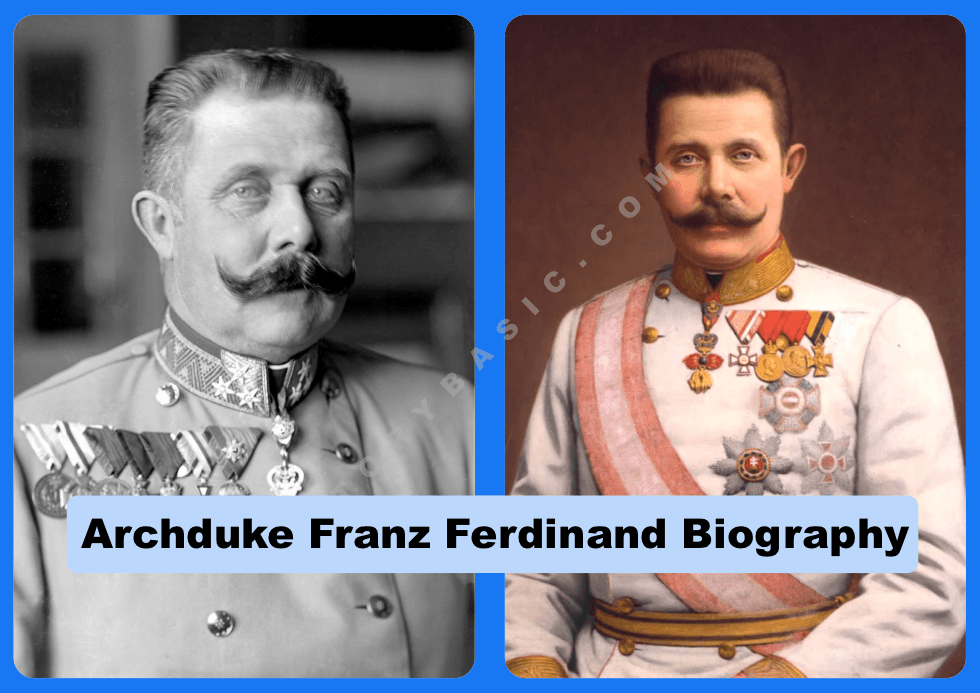
Early Life in the Habsburg Dynasty
Franz Ferdinand was born December 18, 1863, in Graz, Austria, to Archduke Karl Ludwig and Princess Maria Annunziata. As the eldest son of Emperor Franz Joseph’s younger brother, he seemed destined for privilege without ruling burdens. In 1875, his cousin Francis V, Duke of Modena, died and named eleven-year-old Franz Ferdinand his heir, making him extraordinarily wealthy. Crown Prince Rudolf’s 1889 suicide dramatically altered Franz Ferdinand’s trajectory. When his father Karl Ludwig died in 1896, Franz Ferdinand became heir presumptive to the Austro-Hungarian throne.
The Forbidden Romance and Morganatic Marriage
Franz Ferdinand fell in love with Sophie Chotek, a lady-in-waiting lacking the royal pedigree required to marry an heir. The couple kept their relationship secret for years until a discovered locket photograph sparked scandal. Sophie was dismissed and Emperor Franz Joseph forbade the marriage. Franz Ferdinand refused to consider anyone else, creating a constitutional crisis. After intervention by Pope Leo XIII, Tsar Nicholas II, and German Emperor Wilhelm II, Franz Joseph agreed to a compromise in 1899. Franz Ferdinand could marry Sophie, but only morganatically—their descendants would have no throne rights. On June 28, 1900, Franz Ferdinand signed a formal declaration that Sophie would never bear empress titles and their children couldn’t inherit. The July 1, 1900 wedding at Reichstadt was attended only by Franz Ferdinand’s stepmother and her daughters. Upon marriage, Sophie became Princess of Hohenberg, elevated to Duchess in 1909. For fourteen years, Sophie endured court humiliation. She couldn’t ride in the royal carriage or sit in royal boxes. At functions, she stood far from her husband, yielding precedence to all archduchesses. Despite these indignities, their marriage was reportedly happy.
Family Life and Political Influence
Franz Ferdinand and Sophie had three children: Sophie (1901-1990), Maximilian (1902-1964), and Ernst (1904-1954). The children bore the surname von Hohenberg with no succession rights. The family lived on private estates at Konopiště in Bohemia and Artstetten in Lower Austria. Franz Ferdinand was a passionate hunter who shot approximately 300,000 game animals during his lifetime. In 1913, he was appointed inspector general of the army and advocated for federalism and trialism—reorganizing Austria-Hungary to include Slavic lands as a third crown alongside Austria and Hungary. These reform plans made Franz Ferdinand a threat to Serbian nationalist ambitions. Gavrilo Princip later testified that preventing Franz Ferdinand’s reforms motivated the assassination. His strained relationship with Emperor Franz Joseph stemmed from continuous pressure for reforms and bitterness over Sophie’s court treatment.
The Assassination in Sarajevo
In June 1914, General Oskar Potiorek invited Franz Ferdinand to observe military maneuvers in Bosnia-Herzegovina. The visit was scheduled for June 28—the couple’s wedding anniversary and the anniversary of the 1389 Battle of Kosovo, a date holding enormous significance for Serbian nationalists. On June 28, around 10:15 AM, the motorcade traveled through Sarajevo in open cars. Six Bosnian Serb assassins from Young Bosnia, armed with weapons provided by the Black Hand organization, waited along the route. Nedeljko Čabrinović threw a grenade that missed Franz Ferdinand but injured others. After a City Hall reception, Franz Ferdinand insisted on visiting the wounded at the hospital. The motorcade changed routes, but driver Leopold Loyka wasn’t informed. Near the Latin Bridge, Loyka made a wrong turn. When ordered to reverse, the car stalled directly in front of nineteen-year-old Gavrilo Princip. Princip fired twice with an FN Model 1910 pistol. The first bullet hit Sophie in the abdomen, the second struck Franz Ferdinand’s neck. Franz Ferdinand’s last words were: “Don’t die darling, live for our children.” Both died within minutes. Even in death, Sophie faced humiliation—her coffin was placed lower than her husband’s with less decoration.
World War I and Aftermath
Austria-Hungary suspected Serbian involvement in the assassination. On July 28, 1914, exactly one month after the killings, Austria-Hungary declared war on Serbia. The alliance system triggered a chain reaction: the Central Powers (Austria-Hungary and Germany) versus Allied Powers (France, Russia, Britain). Within weeks, all major European powers were at war. World War I ultimately killed approximately 17 million people over four years. Gavrilo Princip and co-conspirators were arrested. Because they were under twenty, they escaped capital punishment. Princip died in prison of tuberculosis in 1918. The Salonika trial revealed connections between assassins and the Black Hand organization, though definitive proof of Serbian government involvement was never established. The war that followed destroyed empires, redrew European borders, and sowed seeds for future conflicts.
Final Thoughts
Archduke Franz Ferdinand’s assassination remains one of history’s most consequential acts of violence. Two shots on a Sarajevo street corner set in motion events that reshaped the modern world and destroyed empires. Franz Ferdinand embodied contradictions—an imperial conservative who advocated reform, a devoted husband who endured public humiliation for love, and an heir to vast power who never wielded it. The tragic irony is that June 28 was chosen because it was his wedding anniversary, one of few dates he and Sophie could celebrate publicly. The very love that defined his life became the circumstance of his death.
Frequently Asked Questions
Q1: When was Archduke Franz Ferdinand assassinated?
Archduke Franz Ferdinand was assassinated on June 28, 1914, in Sarajevo, Bosnia and Herzegovina. He was shot by nineteen-year-old Gavrilo Princip, a Bosnian Serb nationalist. Both Franz Ferdinand and his wife Sophie died from their wounds within minutes.
Q2: Who was Franz Ferdinand’s wife?

Franz Ferdinand married Sophie Chotek in 1900. Sophie was a Bohemian countess who worked as a lady-in-waiting, but she lacked the royal pedigree required for marriage to the Habsburg heir. Their marriage was morganatic, meaning their children had no succession rights to the throne.
Q3: Why did Franz Ferdinand’s assassination cause World War I?
The assassination triggered a diplomatic crisis because Austria-Hungary blamed Serbia for supporting the assassins. Austria-Hungary’s declaration of war on Serbia activated Europe’s alliance system, with Russia supporting Serbia and Germany supporting Austria-Hungary. Within weeks, all major European powers were drawn into the conflict.
Q4: How many children did Franz Ferdinand have?
 Worth" loading="lazy" width="180" height="120">
Franz Ferdinand and Sophie had three children: Sophie (born 1901), Maximilian (born 1902), and Ernst (born 1904). The children bore the surname von Hohenberg and had no rights to the Austrian throne due to their parents’ morganatic marriage.
Q5: What was Franz Ferdinand’s position in Austria-Hungary?
Franz Ferdinand was heir presumptive to the Austro-Hungarian throne. He became heir after Crown Prince Rudolf’s death in 1889 and his own father’s death in 1896. In 1913, he was appointed inspector general of the Austro-Hungarian Armed Forces.
Q6: Who killed Franz Ferdinand and why?
Gavrilo Princip, a nineteen-year-old Bosnian Serb student and member of Young Bosnia, killed Franz Ferdinand. Princip and his co-conspirators sought to free Bosnia from Austro-Hungarian rule and unite South Slavic peoples. Princip later testified that preventing Franz Ferdinand’s planned reforms was also a motivation.
Q7: Where is Franz Ferdinand buried?
Franz Ferdinand and Sophie are buried together in the crypt at Artstetten Castle in Lower Austria. They were denied burial in the Imperial Crypt in Vienna because Sophie’s lower rank meant she could not be interred with full imperial honors alongside her husband.