Lyndon B. Johnson Biography: Presidency & Legacy
Lyndon B. Johnson was the 36th U.S. President (1963-1969), born August 27, 1908. Known for Great Society reforms and Vietnam War. Died January 22, 1973.
- Quick Facts About Lyndon B. Johnson
- Early Life and Family Background
- Education and Teaching Career
- Rise in Washington Politics
- Senate Career and Leadership
- Vice Presidency and Ascension
- The Great Society
- Vietnam War Escalation
- The 1968 Crisis and Withdrawal
- Personal Life and Character
- Retirement and Death
- Legacy and Historical Assessment
- Final Thoughts
- Frequently Asked Questions
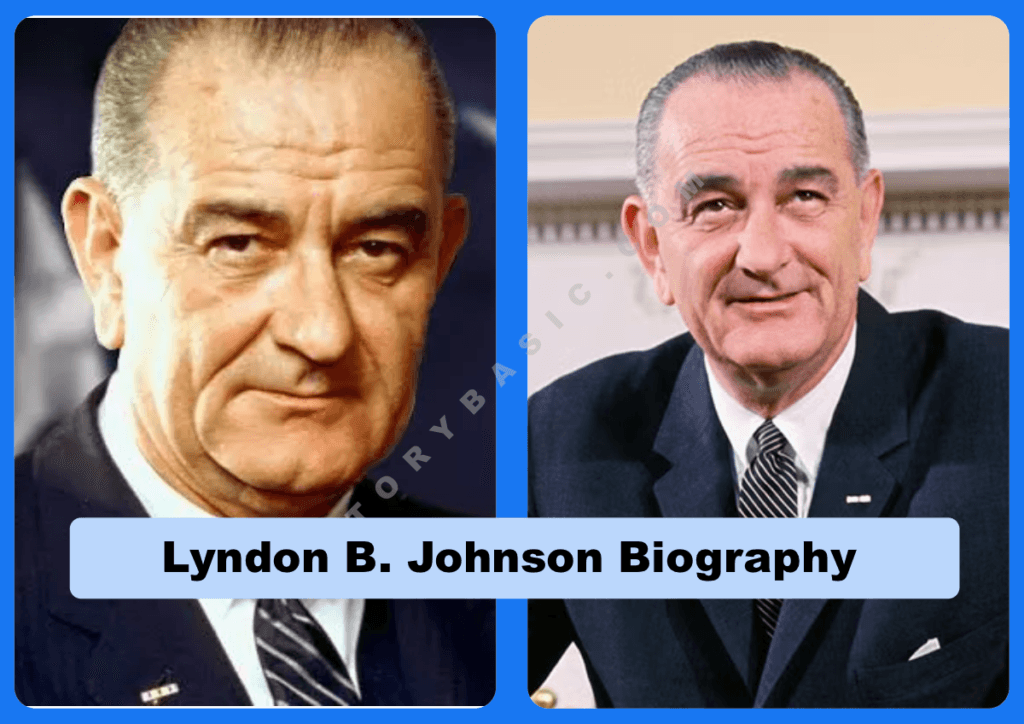
Lyndon Baines Johnson, often called LBJ, served as the 36th President of the United States from 1963 to 1969. Born on August 27, 1908, in the rugged Texas Hill Country, he rose from poverty to become one of the most powerful politicians in American history. His presidency was defined by sweeping domestic reforms and the controversial escalation of the Vietnam War.
Johnson assumed the presidency following President John F. Kennedy’s assassination on November 22, 1963. During his tenure, he signed landmark civil rights legislation and launched the ambitious Great Society programs. However, his legacy remains deeply divided due to his vast expansion of American involvement in Vietnam, which ultimately overshadowed his domestic achievements.
Quick Facts About Lyndon B. Johnson
| Detail | Information |
|---|---|
| Full Name | Lyndon Baines Johnson |
| Date of Birth | August 27, 1908 |
| Date of Death | January 22, 1973 (Age 64) |
| Birthplace | Gillespie County, Texas |
| Profession | Politician, Teacher |
| Political Party | Democratic |
| Presidency | 36th President (1963-1969) |
| Spouse | Claudia “Lady Bird” Johnson |
| Children | Lynda Bird, Luci Baines |
| Famous For | Great Society, Civil Rights Act, Vietnam War |
Early Life and Family Background
Lyndon Johnson was born in Gillespie County, Texas, to Samuel Ealy Johnson Jr., a businessman and Texas state legislator, and Rebekah Baines Johnson. He was the first of five children, with one brother, Sam Houston Johnson, and three sisters: Rebekah, Josefa, and Lucia. In 1913, the family moved to nearby Johnson City, named for a family relative.
Lyndon’s father and maternal grandfather were politicians in Texas, and he loved campaigning across the Hill Country with his father. At age ten, young Lyndon began accompanying his father to the Capitol in Austin to watch legislative debates and absorb political strategy. These early experiences shaped his understanding of power and persuasion.
His mother was reserved and genteel while his father was a talker and a dreamer. Rebekah Baines Johnson was college-educated, an uncommon achievement for a rural woman in the early 1900s. She instilled values of education and culture in her children and had especially grand dreams for Lyndon, her adored firstborn.
The Johnson family experienced financial hardship throughout Lyndon’s childhood. The family house, while comfortable by the standards of the rural South at the time, had neither electricity nor indoor plumbing. When he was twelve, he told classmates, “You know, someday I’m going to be president of the United States”.
Education and Teaching Career
Lyndon graduated from Johnson City High School in 1924, president of his six-member senior class. Despite his parents’ wishes, he initially resisted college and drove to California with friends, taking odd jobs. After a period of drift that included manual labor on a road crew, he refocused on education in 1927.
He was accepted to Southwest Texas State Teachers College. Johnson proved an indifferent student academically but eagerly pursued extracurricular activities including journalism, student government, and debating. His real talent emerged during student teaching.
He was assigned to a tiny Hispanic school in the deeply impoverished area of Cotulla, Texas. Johnson literally took over the school, pushing the long-neglected students and giving them hope and pride in their achievements. This experience profoundly influenced his later commitment to education and helping the disadvantaged.
Rise in Washington Politics
In 1931, newly elected U.S. Congressman Richard Kleberg asked Johnson to come to Washington to work as his top aide. Over the next three years, Lyndon established his reputation as a tireless worker on Capitol Hill. In 1933, at age 24, he was elected speaker of the “Little Congress,” an organization of congressional workers.
On November 17, 1934, after a ten-week courtship, Lyndon and Claudia “Lady Bird” Taylor married in San Antonio. Lady Bird became his closest adviser and principal cheerleader, supporting his political ambitions while managing their growing responsibilities.
Johnson won election to Congress himself in 1937, representing Texas’s 10th district. He quickly became a protégé of President Franklin D. Roosevelt and a strong supporter of New Deal programs. His legislative skills and ability to forge coalitions became evident early in his congressional career.
Senate Career and Leadership
When Texas congressman Lyndon Johnson won election to the Senate in 1948, he took the hotly contested race by a margin of just 87 votes, earning the nickname “Landslide Lyndon”. Election judge Luis Salas said in 1977 that he had certified 202 fraudulent ballots, 200 for Johnson, though Johnson’s victory was upheld.
Once in the Senate, he quickly allied himself with Senator Richard B. Russell, the Georgia Democrat who chaired the Senate Armed Services Committee. With Russell’s support, Johnson became Democratic whip in 1951 and Democratic leader in 1953. When his party regained control of the Senate in 1955, Johnson became majority leader.
 Worth" loading="lazy" width="180" height="120">
As leader, Johnson relied heavily on his powers of persuasion, a strategy known as the “Johnson Treatment,” which he used to guide to passage such legislation as the Civil Rights Act of 1957. His mastery of the Senate and ability to build consensus made him one of the most effective majority leaders in American history.
Vice Presidency and Ascension
In 1960, Johnson sought the Democratic presidential nomination but lost to John F. Kennedy. Kennedy selected Johnson as his running mate because the Texan—southern, Protestant, mature, and the ultimate congressional insider—would be a perfect contrast to the northeastern, Catholic, youthful Democratic nominee. The Kennedy-Johnson ticket narrowly won the 1960 election.
As vice president, Johnson felt relegated to the outer circles of the Kennedy administration despite receiving some significant responsibilities. Kennedy’s assassination on November 22, 1963, sent Johnson to the White House. He was sworn in aboard Air Force One, with a blood-stained Jacqueline Kennedy standing beside him.
The Great Society
Johnson obtained enactment of measures President Kennedy had been urging at the time of his death—a major civil rights bill and a tax cut. He urged the nation “to build a great society, a place where the meaning of man’s life matches the marvels of man’s labor”.
In 1964, Johnson won the presidency over Arizona senator Barry Goldwater by more than 15 million votes. His landslide victory gave him a heavily Democratic Congress and the political capital to enact his ambitious domestic agenda.
In 1965, Johnson enacted legislation augmenting federal aid to education and the creation of Medicare. On August 6, 1965, he signed the Voting Rights Act, which removed legal obstacles preventing African Americans from exercising the right to vote. Other Great Society programs included Medicaid, job training initiatives, urban renewal projects, and conservation efforts.
From 1964 to 1967, federal expenditures on education rose from $4 billion to $12 billion, while spending on health rose from $5 billion to $16 billion. These programs transformed American society and significantly reduced poverty rates during Johnson’s presidency.
Vietnam War Escalation
While Johnson achieved remarkable success domestically, his presidency became consumed by the Vietnam War. During his administration, he greatly expanded American involvement in the Vietnam War despite national opposition.
In February 1965, after an attack on a U.S. military base in Pleiku, Johnson ordered “Operation Rolling Thunder,” massive bombing raids on North Vietnam. Fifty thousand additional troops were sent in July, and by the end of the year the number of military personnel had reached 180,000. The number increased steadily, peaking at about 550,000 in 1968.
By 1968, the United States had 548,000 troops in Vietnam and had already lost 30,000 Americans there. Johnson’s approval ratings had dropped from 70 percent in mid-1965 to below 40 percent by 1967. The president privately lamented, “I can’t get out, I can’t finish it with what I have got.”
The enormous financial cost of the war, reaching $25 billion in 1967, diverted money from Johnson’s cherished Great Society programs and began to fuel inflation. Johnson faced an impossible dilemma between funding domestic programs and maintaining military commitments abroad.
The 1968 Crisis and Withdrawal
The Tet Offensive in early 1968 proved a turning point. Although militarily unsuccessful for North Vietnam, the coordinated attacks shocked the American public and undermined confidence in Johnson’s assurances about the war’s progress. Antiwar protests intensified across the country.
 Worth" loading="lazy" width="180" height="120">
By 1968, Johnson knew he was unlikely to win another presidential election; his increase of American involvement in the Vietnam War, as well as rising American casualties in Vietnam, had made him deeply unpopular. Senator Eugene McCarthy challenged Johnson in the Democratic primaries, nearly defeating the incumbent in New Hampshire.
On March 31, 1968, Johnson addressed the nation about Vietnam and concluded with a stunning announcement: he would not seek reelection. He insisted that he wished to devote his full energies to seeking peace.
Personal Life and Character
Johnson married Lady Bird Taylor in 1934, and their partnership endured throughout his political career. They had two daughters, Lynda Bird and Luci Baines. Lady Bird was instrumental in his success, managing family finances, supporting his campaigns, and serving as a trusted confidante.
Johnson was known for his imposing physical presence, standing over six feet tall, and his aggressive, persuasive style. The “Johnson Treatment” involved getting close to people, using physical intimidation combined with charm, and relentlessly working to win them over. He was demanding of staff but also capable of great loyalty and generosity.
His personality combined enormous ambition with genuine concern for the disadvantaged. His experiences with poverty shaped his commitment to social programs. Yet he was also consumed by insecurity and a desperate need for approval and success.
Retirement and Death
After leaving office in January 1969, Johnson retired to his Texas ranch. He remained largely out of public view, working on his memoirs and participating in occasional public events. His health deteriorated due to heart disease and the stress of his presidency.
Johnson died on January 22, 1973, at his Texas ranch. One of the last calls he received was from President Nixon, suggesting that a Vietnam peace agreement was about to be signed. He was 64 years old.
Legacy and Historical Assessment
Public opinion and academic assessments of Johnson’s legacy have fluctuated greatly. Historians and scholars rank Johnson in the upper tier for his accomplishments regarding domestic policy. His civil rights achievements and Great Society programs fundamentally transformed American society.
Conversely, Johnson is heavily criticized for his foreign policy, namely escalating American involvement in the Vietnam War. The war cost over 58,000 American lives and countless Vietnamese casualties, while dividing the nation and undermining trust in government.
Johnson himself recognized this duality. “That bitch of a war,” Johnson later said, “killed the lady I really loved—the Great Society”. He understood that Vietnam had consumed the presidency he had hoped to devote to domestic reform.
Final Thoughts
Lyndon B. Johnson remains one of American history’s most complex and contradictory figures. He achieved legislative successes unmatched since Franklin Roosevelt, passing transformative civil rights and social welfare programs that improved millions of lives. His commitment to racial justice and economic opportunity reflected genuine conviction shaped by his own experiences with poverty.
Yet his escalation of the Vietnam War represents one of the greatest foreign policy disasters in American history. His inability to extricate the nation from an unwinnable conflict destroyed his presidency and divided the country for generations. The guns-versus-butter dilemma ultimately meant that both his foreign and domestic legacies were compromised.

Johnson’s story illustrates the limits of political power and the tragic consequences when leaders feel trapped by circumstances they helped create. His presidency serves as both an inspiration for what government can accomplish and a cautionary tale about hubris and the costs of war.
Frequently Asked Questions
Q1: Who was Lyndon B. Johnson?
Lyndon B. Johnson was the 36th President of the United States, serving from 1963 to 1969. Born on August 27, 1908, in Texas, he assumed the presidency following John F. Kennedy’s assassination. He was known for his Great Society domestic programs and escalation of the Vietnam War.
Q2: What was the Great Society?
The Great Society was Johnson’s ambitious set of domestic programs aimed at eliminating poverty and racial injustice. It included Medicare, Medicaid, federal aid to education, the Voting Rights Act, job training programs, and urban renewal initiatives. These programs significantly expanded the federal government’s role in social welfare.
Q3: Why did Johnson escalate the Vietnam War?
Johnson escalated U.S. involvement in Vietnam due to Cold War containment policies, fears of appearing weak on communism, and concerns about American credibility. He believed withdrawal would undermine his domestic agenda by empowering conservative critics. The escalation ultimately proved disastrous for his presidency.
Q4: What was the “Johnson Treatment”?
The “Johnson Treatment” was Johnson’s legendary style of personal persuasion. It involved getting physically close to people, using his imposing six-foot-three frame, and combining charm, cajolery, and pressure to win them over. This technique was highly effective in his Senate leadership and legislative negotiations.
Q5: How did Johnson become president?
Johnson became president following President Kennedy’s assassination on November 22, 1963, in Dallas, Texas. As vice president, he automatically succeeded to the presidency and was sworn in aboard Air Force One that same day. He won election in his own right in 1964.
Q6: What major civil rights legislation did Johnson sign?
Johnson signed the Civil Rights Act of 1964, which ended discrimination in employment and public accommodations, and the Voting Rights Act of 1965, which removed obstacles to African American voting. These landmark laws fundamentally transformed race relations in America and remain among his greatest achievements.
Q7: Why didn’t Johnson seek reelection in 1968?
Johnson withdrew from the 1968 presidential race due to declining public support over Vietnam, health concerns, and the likelihood of defeat. His announcement on March 31, 1968, shocked the nation. He stated he wanted to devote full energy to seeking peace in Vietnam.