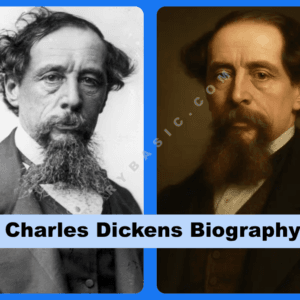
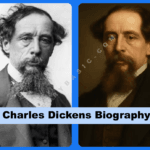
Charles Dickens biography — explore his life, books, early struggles, writing career, personal life, achievements, and the legacy of England’s greatest novelist.
- Key Highlights of Charles Dickens Biography
- Early Life and Background
- Education and Early Career
- Major Literary Career and Achievements
- Notable Works
- Personal Life and Relationships
- Philanthropy and Social Impact
- Later Years and Death
- Achievements and Legacy
- Interesting Facts
- Conclusion
- FAQs about Charles Dickens Biography
Whenever I revisit the Charles Dickens biography, I’m reminded how his life itself reads like a novel — full of hardship, perseverance, and triumph. Born in Portsmouth, England, in 1812, Dickens rose from a childhood marked by poverty to become one of the most celebrated authors in English literature. His works such as Oliver Twist, A Christmas Carol, and Great Expectations didn’t just entertain — they exposed the harsh realities of Victorian society. Through his writing, Dickens transformed social consciousness, giving a voice to the voiceless.
Key Highlights of Charles Dickens Biography
| Category | Details |
|---|---|
| Full Name | Charles John Huffam Dickens |
| Date of Birth | February 7, 1812 |
| Place of Birth | Portsmouth, England |
| Date of Death | June 9, 1870 |
| Age at Death | 58 years |
| Nationality | British |
| Occupation | Novelist, Journalist, Social Critic |
| Education | Limited formal education; largely self-taught |
| Spouse | Catherine Hogarth (m. 1836 – 1858, separated) |
| Children | 10 |
| Notable Works | Oliver Twist, A Christmas Carol, David Copperfield, Bleak House, Great Expectations |
| Estimated Net Worth (historical equivalent) | Approx. £7 million (modern value) |
| Famous For | Depicting Victorian life and advocating social reform |
Early Life and Background
Charles Dickens was born on February 7, 1812, in Portsmouth, England, the second of eight children. His father, John Dickens, was a naval clerk with a cheerful personality but poor financial management, while his mother, Elizabeth, aspired to run a school. When Charles was only 12, his father was imprisoned for debt — an event that left a deep emotional scar and heavily influenced his later writings.
To support his family, young Charles worked in a blacking factory, labeling bottles for six shillings a week. This experience of child labor and social inequality became a foundation for his empathy toward the poor. Whenever I think about this part of the Charles Dickens biography, it reminds me that great storytelling often grows from personal pain — Dickens’s compassion came from lived hardship.
Education and Early Career
After his father’s release, Dickens returned to school for a short time but received no formal higher education. He later taught himself shorthand and began working as a reporter. His early career as a parliamentary journalist in London honed his sharp observational skills and gift for dialogue — qualities that later defined his novels.
 Worth, Age" loading="lazy" width="180" height="120">
His first story, A Dinner at Poplar Walk, was published in 1833 under a pseudonym. By 1836, Dickens gained national recognition with the publication of The Pickwick Papers, a humorous series that became a cultural phenomenon. From then on, his rise was unstoppable.
Major Literary Career and Achievements
Dickens’s writing career spanned more than three decades, producing some of the most influential works in English literature. His novels were typically serialized in magazines — making them accessible to the working class and creating anticipation among readers.
Notable Works
- Oliver Twist (1837–1839): Exposed child labor and poverty.
- Nicholas Nickleby (1838–1839): Highlighted abuse in boarding schools.
- A Christmas Carol (1843): Revived the Christmas spirit and moral reflection.
- David Copperfield (1849–1850): Semi-autobiographical masterpiece.
- Bleak House (1852–1853): Critiqued the English legal system.
- Great Expectations (1860–1861): Explored ambition, class, and redemption.
Each of these works reflected social realities Dickens experienced firsthand. Reading Oliver Twist as a teenager, I felt his outrage at the injustice endured by orphans — it’s easy to see why his novels became tools of reform as much as art.
Personal Life and Relationships
In 1836, Dickens married Catherine Hogarth, daughter of his newspaper editor. They had ten children together, though their marriage eventually deteriorated due to personal and emotional distance. The couple separated in 1858.
 Worth" loading="lazy" width="180" height="120">
Despite his fame, Dickens often struggled with emotional turmoil. He maintained close friendships with several women, most notably actress Ellen Ternan, who is believed to have been his companion until his death. Dickens was also known for his energy — editing magazines, running charity events, and giving dramatic public readings of his works.
Philanthropy and Social Impact
Dickens’s empathy for society’s poor was not limited to his writing. He used his influence to promote social reform, working to improve education, sanitation, and the rights of the underprivileged. He was actively involved with charities supporting women in poverty and orphaned children.
Through stories like Hard Times and Little Dorrit, Dickens shed light on industrial exploitation and the dehumanizing effects of poverty. His novels didn’t just entertain — they transformed public awareness and even influenced laws related to labor and education.
Later Years and Death
In the 1860s, Dickens embarked on extensive reading tours across the United States and Europe. His performances drew massive crowds and solidified his celebrity status. However, the physical toll of these tours, combined with his relentless writing schedule, began to affect his health.

In June 1870, while working on his final, unfinished novel The Mystery of Edwin Drood, Dickens suffered a stroke at his home in Kent. He died the following day at the age of 58 and was buried in Poets’ Corner at Westminster Abbey — an honor reserved for England’s greatest writers.
Achievements and Legacy
Few authors have influenced global culture as profoundly as Dickens. His works have never gone out of print and continue to inspire countless film, stage, and television adaptations. Beyond entertainment, Dickens’s stories ignited compassion and reform in an era of stark inequality.
His influence extended into language itself — phrases like “Scrooge,” “Bleak House,” and “Barkis is willin’” entered everyday speech. Scholars often credit him with shaping modern realism and the serialized novel form. In every sense, Dickens was a literary reformer as well as a storyteller.
Whenever I reflect on his journey, I see how Dickens’s life embodies resilience — the idea that adversity, when channeled creatively, can uplift millions.
Interesting Facts
- Dickens walked more than 20 miles a day around London, drawing inspiration from its streets.
- He kept a raven named Grip, which later inspired Edgar Allan Poe’s poem The Raven.
- He was one of the first global celebrities, performing dramatic readings for paying audiences.
- A Christmas Carol was written in just six weeks.
- Queen Victoria was among his admirers and once invited him to Buckingham Palace.
Conclusion
The Charles Dickens biography is the tale of an underdog who turned hardship into human empathy and art. From child labor to literary glory, Dickens’s story reminds us that personal struggle can become a force for social good. His novels remain timeless mirrors of humanity — funny, tragic, hopeful, and wise.
What makes Dickens truly remarkable isn’t just his storytelling, but his enduring mission: to make readers care about the people society often forgets. More than a century later, that mission still feels urgently relevant.
FAQs about Charles Dickens Biography
1. Who was Charles Dickens?
Charles Dickens was a 19th-century British novelist, journalist, and social critic known for works like Oliver Twist and Great Expectations.
2. What are Charles Dickens’s most famous books?
His most celebrated books include A Christmas Carol, David Copperfield, Bleak House, and Great Expectations.
3. How did Charles Dickens die?
He died on June 9, 1870, from a stroke, at age 58, while working on The Mystery of Edwin Drood.
4. Was Charles Dickens married?
Yes. He was married to Catherine Hogarth from 1836 until their separation in 1858. They had ten children.
5. What was Charles Dickens’s legacy?
His legacy lies in his powerful storytelling, social criticism, and deep compassion for humanity — transforming literature and inspiring social change.